
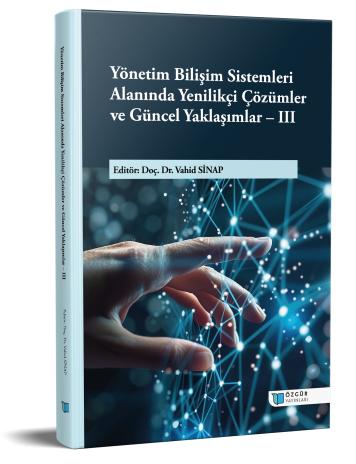
Generative AI and the Strategic Redefinition of Enterprise Information Systems
Chapter from the book:
Sinap,
V.
(ed.)
2025.
Innovative Solutions and Contemporary Approaches in Management Information Systems - III.
Synopsis
The rapid progress of artificial intelligence has pushed the field of Management Information Systems (MIS) into a period of major transformation. Organizations must reconsider how data is structured, how daily operations are executed, and even how strategic decisions are made. For many years, AI systems in business primarily handled tasks with clear rules and predictable outcomes. With the rise of generative AI (GenAI), this narrow focus has widened dramatically, bringing creativity, synthesis, and exploratory analysis to the forefront of technological strategy. This chapter examines how GenAI is reshaping MIS and clarifies its departure from traditional discriminative AI approaches. Discriminative models learn decision boundaries to classify or predict predefined categories, excelling at tasks like fraud detection or credit scoring but incapable of producing new content. GenAI, by contrast, models the joint probability structures of data, enabling the generation of novel outputs (text, code, images, etc.) beyond the training examples. This paradigm shift compels organizations to adopt hybrid MIS architectures: traditional discriminative tools remain essential for high-speed, precision tasks, while GenAI introduces a new layer dedicated to experimentation, content creation, and innovation. Technologically, this transition is underpinned by sequence-to-sequence Transformer architectures and large language models (LLMs). To sustainably integrate GenAI into MIS, firms must actively manage new risks by establishing robust ethical and governance frameworks. Three strategic priorities emerge for MIS leaders: incorporating retrieval-augmented generation (RAG) for more reliable, fact-grounded outputs, expanding the use of low-code/no-code platforms to democratize analytics, and investing in reinforcement learning from human feedback (RLHF) to align AI behavior with human values. By balancing innovation with responsible governance, enterprises can leverage GenAI to radically enhance decision-making and operational performance without compromising security or ethics.
How to cite this book
License

This work is licensed under a Creative Commons Attribution-NonCommercial 4.0 International License.
Published
DOI
Categories
Copyright (c) 2025 Vahid Sinap; Vahid Sinap- Cevher Özden- Hakan Kaya- Kürşat Arslan- Mehmet Fatih Karaca