
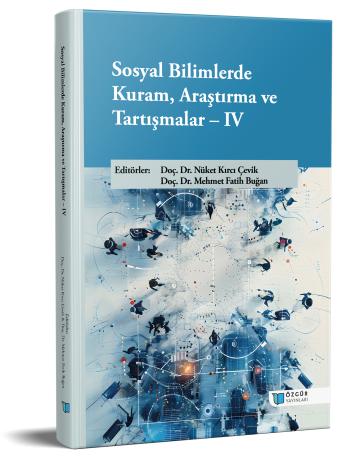
Regenerative Fiscal (ReFi) Paradigm: Institutional Design for Living Systems
Chapter from the book:
Kırcı Çevik,
N.
&
Buğan,
M.
F.
(eds.)
2025.
Theory, Research and Debates in Social Sciences - 4.
Synopsis
This chapter aims to contribute to the academic debate on restructuring economic systems in harmony with the natural world. The Regenerative Finance (ReFi) paradigm is a new model that places financial sustainability and ecological integrity at its core. The chapter seeks to reconcile concepts in ecological economics, blockchain technology, and public finance to explain how financial systems can adapt to support living systems rather than exploiting them for profit. This research explores how ReFi can serve as an institutional framework that transforms institutions for the Global Commons. Using a literature-based systematic review and inter-comparative methodology, the chapter synthesizes cross-disciplinary concepts from economics, environmental studies, and digital governance to create an ecosystem-oriented conceptual model of regenerative public finance. Drawing on works by Daly, Fullerton, Raworth, Sanford, and others, this study examines the relationship between ecological ethics and financial innovation. Through a literature-driven comparative approach, the project examines contemporary models of sustainable finance, regenerative economics, and blockchain-based climate governance to identify their convergences and divergences. This chapter compares sustainable and regenerative paradigms to illustrate the ideological, institutional, and operational traits of ReFi as a new conceptual framework for ecological intervention. The study shows that renewing financial systems requires a shift from extractive and growth-driven models to those based on reciprocity, resilience, and relational value. In this cross-disciplinary fusion, the chapter clarifies that ReFi is not just a technological revolution but a new moral and institutional paradigm for a thriving global economy.
How to cite this book
License

This work is licensed under a Creative Commons Attribution-NonCommercial 4.0 International License.
Published
DOI
Categories
Copyright (c) 2025 Nüket Kırcı Çevik- Mehmet Fatih Buğan; Saim Alper Ayas- Orhan Ecemiş- Orhan Orçun Bıtrak- Pınar Çelik Çaylak- Nisa Ekşili- Gamze Kara Çetinkaya- Gaye Gökalp Yılmaz- Melisa Başkuş- Ali Aslan Şendoğdu- Nezahat Koçyiğit- Şemseddin Gündüz- Esra Pekmez- Eral Ünsaç- Şükrü Mert Karcı- Ceyda Kükrer Mutlu