
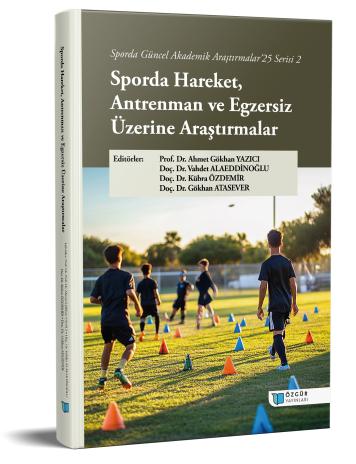
Neuromuscular Adaptation and Movement Quality: Physiological Foundations and Training Applications
Chapter from the book:
Yazıcı,
A.
G.
&
Alaeddinoğlu,
V.
&
Özdemir,
K.
&
Atasever,
G.
(eds.)
2025.
Research on Movement, Training, and Exercise in Sports.
Synopsis
This study explores the impact of neuromuscular adaptation processes on movement quality, focusing on physiological foundations and training applications. The plasticity of the neuromuscular system, motor unit activation levels, neuromuscular communication, and proprioceptive feedback mechanisms play a critical role in movement efficiency and safety. Resistance training, plyometric exercises, and balance-based protocols stimulate neuromuscular adaptation and enhance movement quality.
The research compares various training protocols using EMG, motion analysis systems, and functional movement screening tests to evaluate motor control, muscle activation patterns, and movement symmetry. Findings indicate that neuromuscular adaptation significantly improves movement economy and postural stability, especially in multi-joint and complex movements.
In conclusion, integrating neuromuscular targets into training design offers a strategic approach to performance enhancement and injury prevention. Movement quality is shown to rely not only on biomechanical factors but also on neurophysiological foundations. The study recommends developing individualized, physiology-based training models to optimize functional capacity and long-term athletic development.
Keywords:
How to cite this book
License

This work is licensed under a Creative Commons Attribution-NonCommercial 4.0 International License.
Published
DOI
Categories
Copyright (c) 2025 Ahmet Gökhan Yazıcı- Vahdet Alaeddinoğlu- Kübra Özdemir- Gökhan Atasever; Sefer Karabağ- Fatih Kıyıcı- Ömer Yaşa- Muharrem Ogan- Mehmet Karasu- Gökhan Atasever- Ahmet Dal- Fatmanur Er- Yusuf Ziya Doğru- Elif Akkuş- Alperen Bektaş