
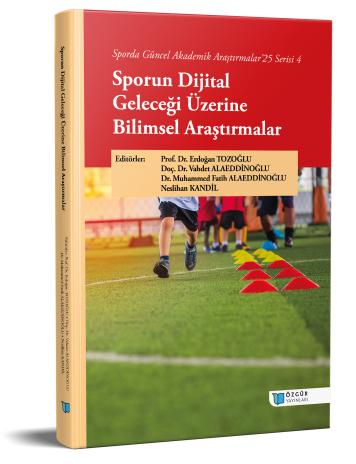
Evaluation of Cognitive Performance in Sports Using Neuroimaging: Eeg and Event-Related Potentials Approaches
Chapter from the book:
Tozoğlu,
E.
&
Alaeddinoğlu,
V.
&
Alaeddinoğlu,
M.
F.
&
Kandil,
N.
(eds.)
2025.
Scientific Research on the Digital Future of Sports.
Synopsis
Elite athletic performance is not solely the result of physical capacity (strength, endurance, speed), but is also directly related to the effective management of perceptual and cognitive processes. Parameters such as decision-making speed, selective attention, impulse control (inhibition), and cognitive flexibility are critical factors that determine success on the field. This book chapter comprehensively covers Electroencephalography (EEG) and Event-Related Potentials (ERP) methods used in sports science to objectively measure cognitive processes. The chapter explains the physiological basis of EEG signals, the international 10-20 electrode placement system, frequency bands, and artifact management techniques in detail. In particular, the procedures for obtaining ERP signals are examined step by step: marker sending, segmentation, baseline correction, and averaging to increase the Signal-to-Noise Ratio (SNR). Finally, the adaptation of neuropsychological test batteries such as Stroop and Go/No-Go to the sports environment and the relationship between the obtained ERP components (P300, N200) and athlete performance are discussed in light of the literature.
How to cite this book
License

This work is licensed under a Creative Commons Attribution-NonCommercial 4.0 International License.
Published
DOI
Categories
Copyright (c) 2025 Erdoğan Tozoğlu- Vahdet Alaeddinoğlu- Muhammed Fatih Alaeddinoğlu- Neslihan Kandil; Murat Turan- Buğra Çağatay Savaş- Muhammet Mavibaş- Muhammet Emin Dertli- Seda Erden Dertli- Tolga Turay- Şükran Dertli- Onur Erdem Korkmaz