
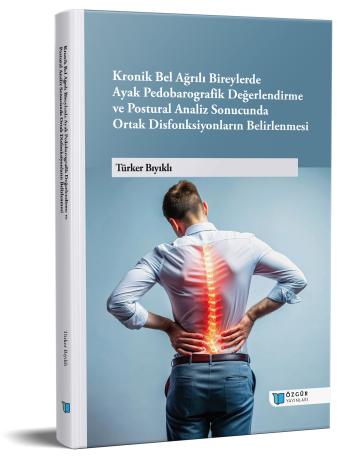
Identification of Common Dysfunctions in Individuals with Chronic Low Back Pain Based on Foot Pedobarographic Evaluation and Postural Analysis
Synopsis
In this study, the evaluation of the presence of gastrocnemius muscle shortness in people with chronic low back pain, the lower extremity biomechanics; This study was carried out to investigate the possible changes in function, posture, pain status and plantar pressure distribution parameters. In the study, the Silfverskiöld method was used to determine GK shortness. According to the measurement results, it was determined that there were male and female participants who may have gastrocnemius muscle shortness. A total of 50 individuals, female (n=33) and male (n=17), were included in the study. It was determined as female participants (mean age 38.27±6.96 years) and male participants (mean age 38.82±765 years). After recording the demographic information of all participants, belonging to both groups; Measurements were performed for parameters of lower extremity biomechanical evaluations.
These parameters are; Subtalar, ankle and knee joint range of motion angular values, knee joint valgite angle and Q angle measurements, knee flexors and hip flexors were determined as muscle shortness measurements and HVA, and measurements were performed using a goniometer. Functional measurements of the feet and ankles of the individuals were made by performing the Navicular Drop Test. Inclinometer was used during the measurements in order to evaluate the sacral inclination angle, which is another parameter. The Modified Schober Test method was preferred in the measurements of lumbar region extensor movements related to muscle shortness. Static plantar pressure measurements were performed to evaluate the plantar pressure distribution and general posture. Pedobarography device was used during the measurements. with these parameters. For comparison of foot posture, the American Society of Orthopedic Surgeons Ankle and Hindfoot Scale (AOFAS) was applied.
As a result of AOFAS, the physical and functional conditions of the foot were evaluated and the findings of the parameters related to the lower extremity were compared. First of all, the visual analog scale (VAS) was used to evaluate the low back pain of individuals. In order to support the data obtained, the Oswestry Disability Index assessment was made on the individuals. The results were used to compare lower extremity parameters and posture. As a result of the study, it was determined that the gastrocnemius muscle shortening was found in male and female participants with chronic low back pain, and this situation may cause limitation of movement while performing active and passive dorsi flexion of the ankle (p<0.05). The fact that most people experience pain during movement within the scope of the visual analog scale supports this situation. It was noted that most of the participants were in the "poor posture" class according to the total score, but there was no significant difference between the two groups (p>0.05). According to the Oswestry Disability Index, the mean of men was higher than that of women, but there was no significant difference (p>0.05). During this evaluation, it was determined that the participants were mostly in the "severely inadequate" category. It was determined that the values related to the amount of NDT, in which the functionality was evaluated, formed a significant relationship with the Q angle values and this relationship was realized in a positive direction (p=0.000). As a result, the data related to the Q angle; determined to measure its effect on posture, pain, ODI and foot functionality; Analysis of the New York Posture Questionnaire, AOFAS, ODI and VAS values was performed.
According to the results, it was determined that there was a moderate positive correlation between the ODI scores of the individuals and the measurement results of the Q angle. It was determined that the increase in the Q angle may also cause an increase in the ODI scores and that there is a statistically significant relationship between all parameters (p<0.001). The relationship between dorsi flexion of the ankle in knee extension connected to the lower extremity and AOFAS and ODI was evaluated. In conclusion; It was observed that there was a negative correlation between the ankle dorsi flexion parameter in extension and the total score of the ODI index, and a positive correlation between the AOFAS values. This situation was found to support the limitation of chronic low back pain (p<0.001). It was observed that the pressure distribution of the fore and hind legs directly affected the posture, and at the same time, there was a negative correlation between the postural data and the ODI values (p<0.001). According to the results, it was observed that the shortness of the gastrocnemius muscle affects the biomechanical and functional process of the lower extremity and this effect causes changes in the way the foot is loaded on the ground depending on the plantar pressure. It was concluded that these changes were directly related to the pain levels and posture of the individuals.
How to cite this book
License

This work is licensed under a Creative Commons Attribution-NonCommercial 4.0 International License.
Published
ISBN
DOI
Statistics
Categories
Copyright (c) 2026 Türker Bıyıklı