
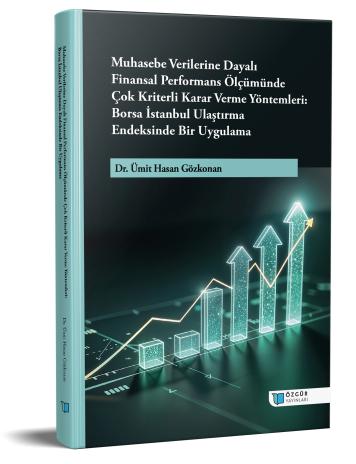
Multi-Criteria Decision-Making Methods in Financial Performance Measurement Based on Accounting Data: An Application in the Borsa Istanbul Transportation Index
Synopsis
In today's increasingly complex financial markets, the sustainability and competitiveness of businesses depend on the accurate, transparent, and multidimensional analysis of their financial performance. Where traditional single-criterion analysis methods fall short, the processing of accounting data using modern decision-making techniques has become a strategic necessity for investors and managers. This book presents a comprehensive performance evaluation model by combining general accounting theory and the analytical power of financial statements with the mathematical perspective of Multi-Criteria Decision Making (MCDM) methods. The first section of the three-part study addresses accounting data and financial statements, which are the basic inputs for financial performance. The analytical meanings of balance sheet and income statement items, the information content of financial ratios, and the role of these data in decision-making processes are conceptualized. The second section examines the theoretical foundation of Multi-Criteria Decision Making (MCDM) methods used in solving complex decision problems. Ranking methods are detailed, forming the methodological foundation of the study. The remainder of the section refers to studies in literature related to the methods used in this study. The third chapter, which constitutes the main contribution of the book, empirically analyzes the financial performance of companies listed on the Borsa Istanbul (BIST) Transportation Index between 2021 and 2024. The study conducts a comparative analysis using five different methods recognized as valid in literature (MAUT, TOPSIS, MABAC, CoCoSo, and MARCOS). The application results reveal the financial stability of companies in the sector, their performance changes over the years, and the consistency levels between the methods. Additionally, the year-based rankings of the methods used in the study were combined using the Borda Count Method to obtain a single ranking covering all years. Subsequently, the aggregate rankings obtained in each method were recombined using the Borda Count Method to obtain a performance ranking covering all years and methods. This study aims to provide a theoretical contribution to accounting and finance literature with its integrated framework, as well as to create a practical roadmap that will guide portfolio managers, investors, and business managers in their strategic decisions.
How to cite this book
License

This work is licensed under a Creative Commons Attribution-NonCommercial 4.0 International License.
Published
ISBN
DOI
Statistics
Categories
Copyright (c) 2026 Ümit Hasan Gözkonan