
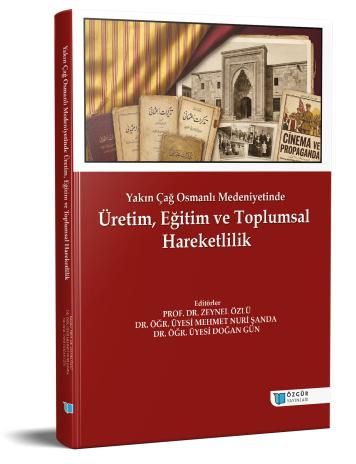
Production, Education, and Social Mobility in the Late Modern Ottoman Civilization
Synopsis
This study, titled "Production, Education, and Social Mobility in Late Modern Ottoman Civilization," examines the profound changes during the transition from the Ottoman Empire to the Republic through various perspectives. The book consists of seven chapters, each tracing a different aspect of social transformation.
In this work, Metin Akis analyzes the industrial heritage through the famous "Kutni" weaving of Kilis; Arzu Çiftsüren and Muhsin Ramazan İşsever examine the perception of the Ottomans through works written in the Indian world. İbrahim Erdoğdu focuses on the continuity of the 19th-century settlement tradition in the case of Niğde during the Republican era, while Semiha Zehra Özharat describes the place of Gaziantep madrasas in the city's cultural memory. Metin Kopar presents the migration and urbanization movements between 1831 and 1955 with data; Mustafa Çabuk discusses how cinema was used as a tool in British propaganda activities in the Middle East during World War I. In the final chapter, Zeynel Özlü and Mustafa Murat Çay explain Ottoman mining policies through archival documents, focusing on the 1894 Manavgat Chrome Mine contract.
Offering a wide range of content from local examples to broad social movements, we hope this collection will be a useful resource for history enthusiasts and students. We would like to thank all our authors who contributed and everyone who supported the preparation of this work.
The Editors
Prof. Dr. Zeynel Özlü
Dr. Öğr. Üyesi Mehmet Nuri Şanda
Dr. Öğr. Üyesi Doğan Gün
Keywords:
How to cite this book
License

This work is licensed under a Creative Commons Attribution-NonCommercial 4.0 International License.
Published
ISBN
DOI
Statistics
Categories
Copyright (c) 2026 Zeynel Özlü- Mehmet Nuri Şanda- Doğan Gün