
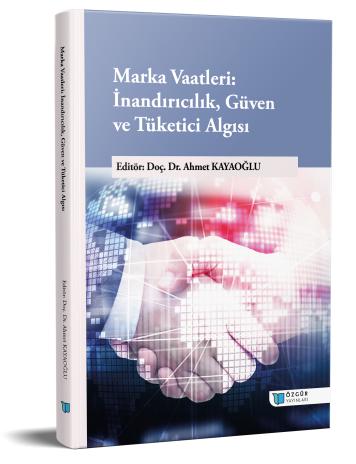
Brand Damage and Reputational Loss: Measurement, Evaluation, and Legal Dimensions
Chapter from the book:
Kayaoğlu,
A.
(ed.)
2026.
Brand Promises: Credibility, Trust, and Consumer Perception.
Synopsis
This study aims to examine the concepts of brand damage and reputation loss within the marketing literature and to contribute to a better understanding of their measurement, evaluation, and legal dimensions. In today's postmodern consumption context, consumers do not only consume the functional benefits of products but also the symbolic meanings and images represented by brands. Consequently, brand reputation has become a significant intangible asset for companies and a strategic element that provides competitive advantage. However, brands may experience reputation loss as a result of crises, scandals, negative news, or unfavorable consumer experiences, which may lead to substantial losses in brand equity.
Within this framework, the study first addresses the concept of brand reputation and explains the process of reputation formation through theoretical perspectives such as signaling theory, negativity bias, and the halo and reverse halo effects. Subsequently, the concepts of brand credibility and brand equity, which are closely associated with reputation, are examined in order to highlight their role in understanding brand damage and reputation loss. The study emphasizes that consumer-based brand equity deterioration represents not only a perceptual decline but also a measurable loss of brand capital.
In this context, the effects of brand damage on consumer perceptions, organizational stakeholder relationships, market performance, and financial indicators are discussed. As a result, the study reveals that brand damage and reputation loss are not merely communication-related issues but multidimensional phenomena with managerial, economic, and legal implications. Accordingly, effective management of brand damage requires a holistic approach that integrates marketing, finance, and legal perspectives.
How to cite this book
License

This work is licensed under a Creative Commons Attribution-NonCommercial 4.0 International License.
Published
DOI
Categories
Copyright (c) 2026 Ahmet Kayaoğlu; Ahmet Kayaoğlu- Bülent Şen- Yavuz Selim Gülmez- Erkut Kuldaş- Büşra İlhan- Uğur Sağlık- Özlem Bulut- Hanife Yeşilyurt