
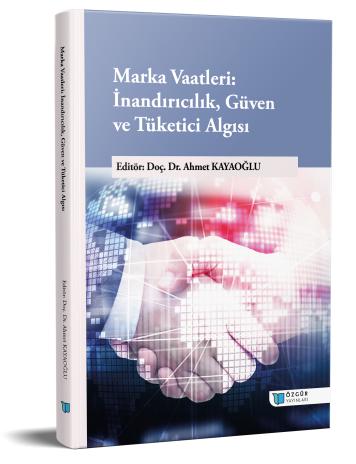
Rebuilding Brand Reputation: Strategies and Practices
Chapter from the book:
Kayaoğlu,
A.
(ed.)
2026.
Brand Promises: Credibility, Trust, and Consumer Perception.
Synopsis
This study conceptually examines the post-crisis reconstruction of brand reputation, which has become increasingly fragile in today’s digitalized and hyper-competitive business environment, through illustrative brand cases. Brand reputation is a multidimensional value shaped by the past experiences and perceptions of consumers, investors, employees, and other stakeholders, and it is regarded as one of the key determinants of sustainable competitive advantage and long-term corporate success. However, the accelerated flow of information through digital media and social networks enables reputational damage to spread globally within a very short time, rapidly eroding brands’ trust capital. In this context, reputational loss is considered not merely a communication problem but a structural breakdown process that generates profound effects on brand loyalty, perceived quality, and corporate identity. The study defines post-crisis reputation rebuilding as a holistic restoration process that goes beyond managing the immediate crisis moment and encompasses responsibility acceptance, transparency, corrective action, and strategic transformation. Within the framework of William L. Benoit’s Image Restoration Theory and W. Timothy Coombs’ Situational Crisis Communication Theory, the effects of denial, responsibility-taking, and compensation strategies on stakeholder perceptions are discussed. Furthermore, through cases such as the Volkswagen emissions scandal and Starbucks, crises are analyzed not only as threats but also as opportunities for strategic repositioning. The findings reveal that communicative statements alone are insufficient; trust can only be restored through concrete, structured, and sustainable changes. In conclusion, the study emphasizes that in the post-crisis period, brands should adopt an accountable and transformation-oriented approach rather than defensive reflexes. Reputation rebuilding is a multilayered process that requires not only managing external stakeholder messages but also restructuring corporate culture, operational processes, and stakeholder relationships. In this regard, a strategic reputation management approach grounded in long-term trust building, supported by transparency and tangible actions, emerges as a necessity.
How to cite this book
License

This work is licensed under a Creative Commons Attribution-NonCommercial 4.0 International License.
Published
DOI
Categories
Copyright (c) 2026 Ahmet Kayaoğlu; Ahmet Kayaoğlu- Bülent Şen- Yavuz Selim Gülmez- Erkut Kuldaş- Büşra İlhan- Uğur Sağlık- Özlem Bulut- Hanife Yeşilyurt