
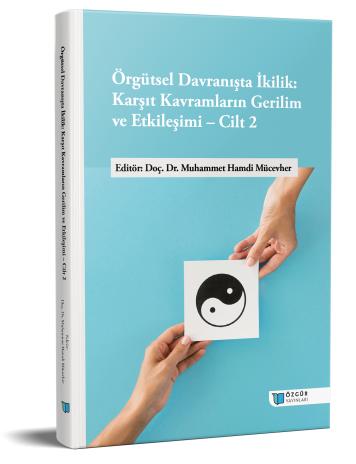
The Justice–Injustice Paradox in Performance Appraisal: Tensions Between Opposing Concepts and Their Organizational Outcomes
Chapter from the book:
Mücevher,
M.
H.
(ed.)
2026.
Dualism in Organizational Behavior: The Tension and Interaction of Opposing Concepts – Volume 2.
Synopsis
This section addresses performance appraisal processes within the framework of the "Fair Performance Appraisal – Perceived Injustice" dichotomy, treating it as a dynamic field of tension rather than an opposition-based distinction. Based on organizational justice theory, the dimensions of distributive, procedural, and interactional justice are explained; it is emphasized that performance appraisal systems are not only technical measurement tools but also social and psychological processes through which employees make sense of their relationship with the organization. Through social change theory and the psychological contract approach, the discussion explores how perceptions of justice are shaped by reciprocity norms and expectation balance. The chapter examines perceived injustice within the context of cognitive and emotional construction processes, revealing the role of social comparison, uncertainty management, and attribution mechanisms in the formation of injustice perceptions. The justice–injustice tension was evaluated from a paradox perspective; it was shown that performance appraisal systems have the potential to both produce justice and create perceptions of injustice simultaneously. The organizational consequences of this tension were analyzed through outcomes such as commitment, burnout, organizational trust, silence, and intention to leave. Within the scope of managerial implications, balancing and tension-exacerbating practices were compared; the power and control dimension of performance regimes was discussed with a critical perspective that goes beyond normative judgment.
How to cite this book
License

This work is licensed under a Creative Commons Attribution-NonCommercial 4.0 International License.
Published
DOI
Categories
Copyright (c) 2026 Muhammet Hamdi Mücevher; Nurdan Oral Kara- Semanur Çelik- Mehmet Beşir Demirbaş- Büşra Aydoğan- Gülçin Gökçenur Karataş- Hilal Erturhan Işkın- Dilan Türk- Murat Karaçetin- Ebru Armutcu- Beyzanur Üstünbaş- Aysel Tamtamış Kurt- Vacide Ancın- Kübra Ağırkaya Çetintürk- İskender Çetintürk- Zeynep Duran- Derya Dinçer Gültekin- Kevser Sezer Korucu