
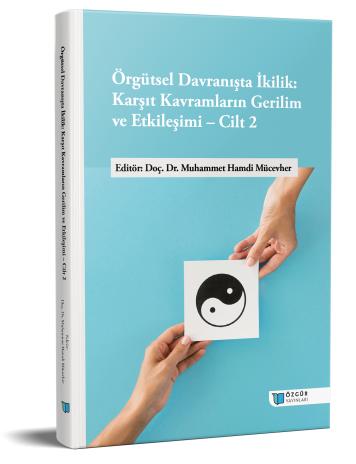
Organizational Conflict Management: From Avoidance Strategy to Creative and Constructive Solutions
Chapter from the book:
Mücevher,
M.
H.
(ed.)
2026.
Dualism in Organizational Behavior: The Tension and Interaction of Opposing Concepts – Volume 2.
Synopsis
This study examines the phenomenon of organizational conflict, an inevitable part of modern organizations, across a broad spectrum ranging from traditional "avoidance" approaches to contemporary "interactionist" and "creative" management strategies. Organizational conflict is a dynamic process arising from incompatibilities and contradictions among individuals or groups regarding goals, resources, and values. Within the scope of this work, the nature and causes of conflict are first explored, followed by an analysis of its developmental process through Pondy’s five-stage model.
One of the primary focal points of this chapter, the conflict avoidance strategy, is addressed through its conceptual framework and its physical and psychological modes of application. While situations where avoidance can be utilized as a strategic choice are noted, it is emphasized that this method—particularly in collectivist cultures or those with high power distance—can transform into a "norm of silence," thereby suppressing creativity.
In the second major axis of the study, creative and constructive conflict, the functional aspects of conflict that enhance performance are highlighted. Based on the "Inverted U" relationship between conflict and performance, it is explained that low levels of conflict lead to stagnation, while high levels lead to chaos; however, an optimal level of conflict triggers innovation. In this context, it is detailed how strategic decision-making techniques such as "Devil’s Advocacy" and "Dialectical Inquiry" prevent the pitfalls of groupthink.
In the final section, the infrastructure required for a constructive conflict climate—namely psychological safety and open communication channels—is discussed alongside the leader's roles as a "facilitator" and "catalyst". Ultimately, it is demonstrated that when managed correctly, conflict serves as a strategic lever that challenges the status quo and fosters organizational learning.
How to cite this book
License

This work is licensed under a Creative Commons Attribution-NonCommercial 4.0 International License.
Published
DOI
Categories
Copyright (c) 2026 Muhammet Hamdi Mücevher; Nurdan Oral Kara- Semanur Çelik- Mehmet Beşir Demirbaş- Büşra Aydoğan- Gülçin Gökçenur Karataş- Hilal Erturhan Işkın- Dilan Türk- Murat Karaçetin- Ebru Armutcu- Beyzanur Üstünbaş- Aysel Tamtamış Kurt- Vacide Ancın- Kübra Ağırkaya Çetintürk- İskender Çetintürk- Zeynep Duran- Derya Dinçer Gültekin- Kevser Sezer Korucu