
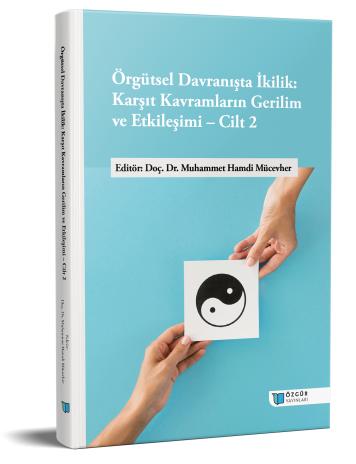
Workplace Civility and Microaggression: Organizational and Managerial Perspectives
Chapter from the book:
Mücevher,
M.
H.
(ed.)
2026.
Dualism in Organizational Behavior: The Tension and Interaction of Opposing Concepts – Volume 2.
Synopsis
This chapter argues that workplace civility and microaggressions can frequently co-occur in organizational life and that their relationship is better understood through a duality/paradox lens rather than a simplistic “good–bad” dichotomy. Civility—grounded in respect, empathy, active listening, and constructive communication—supports employee well-being, organizational commitment, and performance. Microaggressions, by contrast, constitute a domain of risk that undermines psychological safety through repetitive, subtle, and exclusionary messages that need not involve explicit insult. The chapter emphasizes that civility should not be reduced to the mere absence of incivility; instead, it ought to be conceptualized as a proactive organizational capability, underscoring the need for conceptual refinement and the development of valid and reliable multilevel measurement instruments. It further offers a multilevel analysis of the civility–microaggression tension across organizational norms and climate, power relations and hierarchy, leadership styles, cultural values and diversity, and the recursive dynamics through which individuals and organizational structures mutually (re)produce one another. Illustrative cases demonstrate that formal inclusion discourses may remain in tension with tacit power relations embedded in everyday interactions. Finally, the chapter contends that preventing microaggressions should not be confined to awareness training; it must be institutionalized through managerial and policy interventions supported by values-based recruitment, inclusive leadership, transparent feedback and reporting channels, fair performance and promotion systems, and explicit standards of conduct.
How to cite this book
License

This work is licensed under a Creative Commons Attribution-NonCommercial 4.0 International License.
Published
DOI
Categories
Copyright (c) 2026 Muhammet Hamdi Mücevher; Nurdan Oral Kara- Semanur Çelik- Mehmet Beşir Demirbaş- Büşra Aydoğan- Gülçin Gökçenur Karataş- Hilal Erturhan Işkın- Dilan Türk- Murat Karaçetin- Ebru Armutcu- Beyzanur Üstünbaş- Aysel Tamtamış Kurt- Vacide Ancın- Kübra Ağırkaya Çetintürk- İskender Çetintürk- Zeynep Duran- Derya Dinçer Gültekin- Kevser Sezer Korucu