
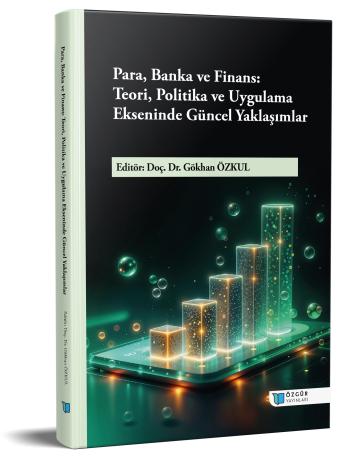
Money, Banking, and Finance: Current Approaches in the Axis of Theory, Policy, and Practice
Synopsis
The global financial system is undergoing one of the fastest and most fundamental transformations in history, driven by technological advancements and digitalization. The traditional understanding of finance is giving way to a dynamic structure dominated by digital ecosystems, financial technologies, and next-generation regulations. In this context, concepts within the triangle of money, banking, and finance have ceased to be merely subjects of theoretical debate; they have transformed into practical realities that need to be closely monitored and analyzed by policymakers, market actors, and academic circles.
This book, titled “Money, Banking, and Finance: Current Approaches in the Axis of Theory, Policy, and Practice” has been penned to address this profound transformation from a multidimensional perspective. The book aims to provide the reader with a comprehensive framework through a systematic flow that starts from theoretical foundations, extends to current policies, and ultimately reaches empirical applications with methodological depth.
In the first chapter of our book, Ali Hüseyin builds the fundamental conceptual foundation of the volume by examining the structural evolution of money and payment systems from traditional to digital, with his study titled “The Evolution of Payment Systems: Structural Transformation from Physical Cash to Digital Payment Ecosystems.” Following this historical and structural evolution, Fırat Cem Doğan opens the policy axis to discussion in the second chapter by addressing “Central Banking, Digital Currencies, and Regulatory Frameworks” focusing on how digitalized money will be managed and regulated by authorities.
In the third chapter, Naci Yılmaz moves the subject from the technological dimension to the market level with his study titled “The Effects of Digital Banking on Money and Capital Markets within the Scope of Financial Innovation” analyzing the reflections of innovations on the financial system. The reflections of these global and conceptual effects specific to Turkey are examined in detail in the fourth chapter by Berna Doğan Başar under the title “The Digital Transformation of the Turkish Banking Sector: FinTech, RegTech and SupTech” with a focus on regulatory and supervisory technologies.
Following the construction of the theoretical and political framework, our book deepens its academic rigor with the final two chapters featuring data- and method-driven empirical applications. In the fifth chapter, Çağrı Köroğlu and Beste Tunalı subject the banking sector to a concrete evaluation through performance and analytical decision models with their study “Evaluation of Private and Public Capital Banks Using Multi-Criteria Decision Making Methods.” In the sixth chapter, which concludes our book, Ahmet Oğuz Akgüneş shifts the discussions from the bank level back to the macroeconomic level with his study titled “Macroeconomic Dynamics of CDS Premiums in Türkiye: An ARDL Approach” modelling Turkey's financial risk indicators through time series analysis.
I would like to express my sincere gratitude to all the chapter authors who contributed to the literature by sharing their valuable academic expertise and visions in the creation of this work, which brings different fields of specialization under one roof. I hope that this work, titled “Money, Banking, and Finance: Current Approaches in the Axis of Theory, Policy, and Practice” will open new horizons for researchers, policymakers, students, and all readers interested in the transformation of the financial ecosystem.
Editor
Assoc. Prof. Dr. Gökhan ÖZKUL
Chapters
How to cite this book
License

This work is licensed under a Creative Commons Attribution-NonCommercial 4.0 International License.
Published
ISBN
DOI
Statistics
Categories
Copyright (c) 2026 Gökhan Özkul; Ali Hüseyin- Fırat Cem Doğan- Naci Yılmaz- Berna Doğan Başar- Çağrı Köroğlu- Beste Tunalı- Ahmet Oğuz Akgüneş