
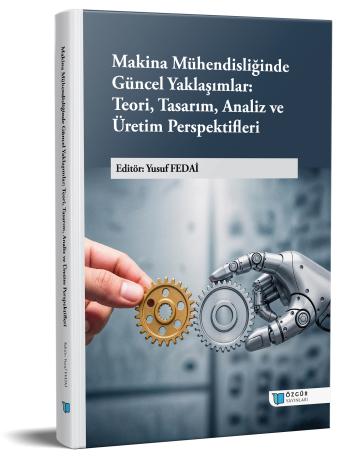
Current Approaches in Mechanical Engineering: Perspectives on Theory, Design, Analysis, and Manufacturing
Synopsis
Mechanical engineering, while being one of the most established disciplines serving humanity by applying the fundamental laws of the physical world, is currently undergoing one of the most radical transformations in its history. Traditional mechanical systems are no longer merely static structures; they have evolved into intelligent organisms equipped with sensors, generating data, and optimized through artificial intelligence. In this new era of Industry 4.0 and beyond, engineering success depends not only on theoretical calculation power but also on how harmoniously this data is blended with advanced manufacturing technologies and digital systems. The 21st-century mechanical engineer must specialize across a broad spectrum, from atomic-level material defects to the architecture of cloud-based autonomous systems.
This book chapter reinterprets the unwavering foundations of mechanical engineering—theory, design, analysis, and manufacturing—through the most current approaches offered by modern technology. The sections within the work aim to strengthen the bridge between academic discipline and industrial application.
The scope of the work ranges from the analytical and numerical (FEM) analysis of Hertzian contact stresses in spur gear systems to the systematic evaluation of porosity mechanisms in Laser Powder Bed Fusion (LPBF), a prominent additive manufacturing technology. Furthermore, the prediction of surface quality in composite materials produced via Fused Deposition Modelling (FDM) using machine learning algorithms and the integration of the Internet of Things (IoT) with artificial intelligence within the context of industrial digital transformation are examined in depth. Synthesizing theory and practice, this chapter serves as a comprehensive guide for both the optimization of traditional mechanical systems and the development of future autonomous and intelligent manufacturing systems.
In conclusion, this book is a comprehensive work that combines theoretical depth with advanced simulation techniques and digital production models. We hope that this work will bring a new breath to the academic world, add permanent value to the manufacturing engineering literature, and serve as a critical reference for professionals in the sector. It is our greatest wish that these chapters, prepared with a modern engineering vision, will shed light on future innovative projects.
Chapters
How to cite this book
License

This work is licensed under a Creative Commons Attribution-NonCommercial 4.0 International License.
Published
ISBN
DOI
Statistics
Categories
Copyright (c) 2026 Yusuf Fedai; Nafel Doğdu- Yunus Kartal- Ramazan Çalışkan- Ali Osman Kurban- Mustafa Çakır