
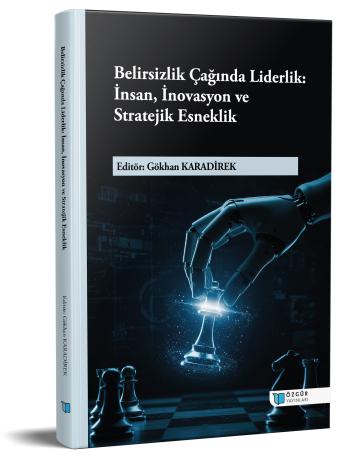
Self-Management and Motivation in an Uncertain Task
Chapter from the book:
Karadirek,
G.
(ed.)
2026.
Leadership in the Age of Uncertainty: Human, Innovation and Strategic Flexibility.
Synopsis
This section addresses the importance of self-management skills in organizational environments where job descriptions are unclear and uncertainty prevails. Self-management is defined as the process of consciously regulating and directing an individual's emotional responses, internal processes, and personal resources. Theoretically, self-management is considered in three basic stages: pre-thinking, performance monitoring, and self-reflection. Today, the concept of self-management is receiving increasing attention in academic literature due to its potential to increase employee motivation and provide organizational competitive advantage. Self-Determination Theory (SDT), which offers a comprehensive framework for explaining individuals' motivational processes, suggests that three basic psychological needs—autonomy, competence, and relatedness—are decisive in the development of self-management skills. In terms of application, concepts such as self-leadership, job crafting, and self-efficacy are stated to be related to an individual's sense of ownership and responsibility towards their work. It is also stated that creating a support ve organizational climate, providing necessary resources, and granting employees an appropriate level of autonomy positively influences the development of self-management skills.
How to cite this book
License

This work is licensed under a Creative Commons Attribution-NonCommercial 4.0 International License.
Published
DOI
Categories
Copyright (c) 2026 Gökhan Karadirek; Yasemin Gülbahar- Nihal Arıcan Kaygusuz- Fatma Yılmaz- Hakan Sipahi- Şerife Karagöz- Semiha Kılçaslan