
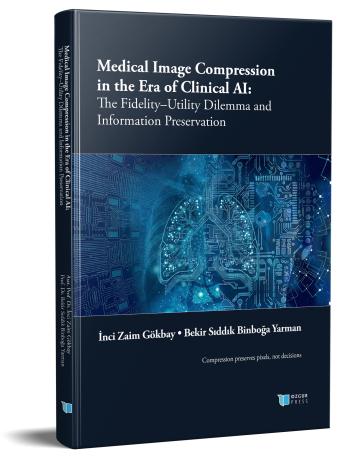
Medical Image Compression in the Era of Clinical Ai the Fidelity– Utility Dilemma and Information Preservation
Synopsis
This monograph was born from a fundamental scientific curiosity—a relentless, meticulous drive to decompose an accepted engineering standard down to its most basic epistemological roots. It is the culmination of a journey that began as a rigorous dialog between a doctoral candidate and her mentor, questioning whether the mathematical perfection of an algorithm truly aligned with biological and diagnostic reality.
The theoretical groundwork for this inquiry derives from the first author’s doctoral dissertation, “Modeling of Biomedical Images via the SYMPES Method” (Gökbay, 2013), completed under the supervision of the second author at Istanbul University. The Classical SYMPES model developed therein was a rigorous instantiation of classical rate–distortion theory, designed to minimize quadratic distortion in intensity space. Under this objective, compression ratios up to 51× were achieved while maintaining PSNR values above 31 dB in moderate-rate regimes. From a pure signal-processing perspective, the equations balanced; the problem appeared solved.
Yet, an analytical mind cannot rest on scalar metrics alone. Discussions with clinicians and a deeper, evidence-based dissection of the results revealed a question that was no longer engineering-based, but epistemological: Was diagnostic information truly preserved?
Classical information theory addresses fidelity using Mean Squared Error (MSE), PSNR, and Structural Similarity (SSIM), implicitly asserting that preserving pixel variance equates to preserving image content. We found that this equivalence holds only within the geometry of intensity space. Clinical decisions—whether rendered by human radiologists or deep neural networks— operate in a structurally distinct realm: representation space, governed by radiomic feature manifolds, morphological topology, and learned embeddings.
Minimization of quadratic distortion does not guarantee stability in these spaces. As we applied Classical SYMPES not merely as a codec, but as an analytically transparent diagnostic instrument, the empirical truth emerged. A compressed CT image may yield PSNR values ≥35 dB while inducing measurable topological perturbations or altering discriminative radiomic signatures. In our TCGA-LUAD stress tests, SSIM values as high as 0.991 coexisted with a 9.3% relative decline in oncological staging AUC. Pixel fidelity remained asymptotically stable; representation fidelity drifted.
We term this structural asymmetry the Variance–Information Fallacy: variance is not a sufficient statistic for diagnostic information.
This monograph revisits the foundational assumptions of classical compression in the context of tomographic imaging. The aim is not to introduce a new codec per se, but to fundamentally reformulate the optimization objective—shifting from pixel-wise energy minimization to task-conditioned structural stability in representation space. These results do not invalidate classical distortion minimization; rather, they demonstrate its incompleteness when the ultimate objective is clinical decision stability in the age of artificial intelligence.
How to cite this book
License

This work is licensed under a Creative Commons Attribution-NonCommercial 4.0 International License.
Published
ISBN
DOI
Statistics
Categories
Copyright (c) 2026 İnci Zaim Gökbay- Bekir Sıddık Binboğa Yaman