
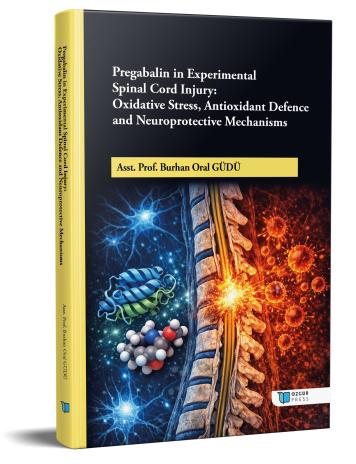
Pregabalin in Experimental Spinal Cord Injury: Oxidative Stress, Antioxidant Defense, and Neuroprotective Mechanisms
Synopsis
Spinal cord injuries are one of the most complex and multifaceted clinical conditions in neurosurgery. Oxidative stress, excitotoxicity, inflammation, and mitochondrial dysfunction, which play a significant role in the damage cascade that develops and is activated after primary mechanical injury, can lead to the deepening of neuronal loss. Understanding and targeting secondary damage at the molecular level remains a fundamental area of research in the development of neuroprotective treatment approaches.
This book is derived from my Medical Specialization thesis, completed in 2012 at the Department of Neurosurgery, Faculty of Medicine, Yüzüncü Yıl University, with YÖK thesis number: 324949, entitled “Neuroprotective effect of Pregabalin in experimental spinal cord injury: Investigation of antioxidant enzymes in blood and neural tissue in terms of oxidative stress.” This thesis has been comprehensively reviewed, restructured, and transformed into an academic monograph format in light of current literature.
This work evaluates the neuroprotective potential of pregabalin in an experimental spinal cord injury model, primarily through endogenous antioxidant systems such as superoxide dismutase and glutathione peroxidase. The findings point to the potential regulatory effects of pregabalin on secondary damage processes and offer new research perspectives in the field of translational neuroprotection.
This book aims not only to present the results of an experimental model but also to discuss the biological and pharmacological foundations and clinical implications of the neuroprotection paradigm in spinal cord injury within a holistic framework.
During the preparation of the text, AI-based language editing tools were used to improve grammatical accuracy and clarity of expression and to detect errors. However, I bear full academic responsibility for all scientific content, data analysis, interpretation, and conclusions presented in this book.
I would also like to express my deepest gratitude to my family for their patience and support throughout my scientific journey.
How to cite this book
License

This work is licensed under a Creative Commons Attribution-NonCommercial 4.0 International License.
Published
ISBN
DOI
Statistics
Categories
Copyright (c) 2026 Burhan Oral Güdü