
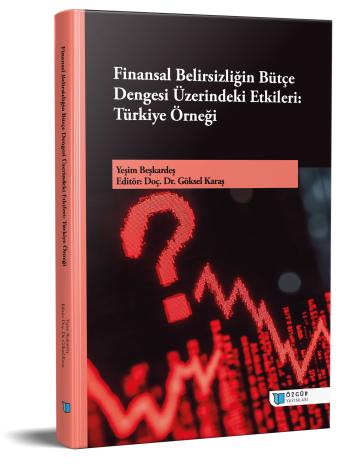
The Effects of Financial Uncertainty on Budget Balance: The Case of Türkiye
Synopsis
As a result of the increasing integration between globalization and financial markets, economic shocks experienced at both national and international levels have begun to be transmitted more rapidly and extensively. This situation has highlighted the importance of uncertainty as a key factor in ensuring macroeconomic stability. The concept of financial uncertainty complicates forward-looking economic decision-making and weakens the effective functioning of the market mechanism. Moreover, it is of critical importance in terms of fiscal discipline and budget balance and constitutes one of the most fundamental indicators for sustaining economic stability.
In this study, the effects of financial uncertainty on the budget balance are examined through the case of Türkiye. Accordingly, the study aims to reveal the effects of uncertainty on fiscal indicators and to provide policy-relevant implications for policymakers from a public finance perspective. For this purpose, the impacts of uncertainty indicators and macroeconomic variables on the budget balance are analyzed. Within this framework, quarterly data covering the period 2006Q1–2024Q4 for Türkiye are employed, and the relationships between the ratio of the budget balance to GDP and economic policy uncertainty, macroeconomic uncertainty, inflation, and financial volatility are analyzed using the ARDL bounds testing approach. The empirical findings indicate that the budget balance exhibits a sensitive structure in response to both global uncertainty indicators and domestic macroeconomic dynamics.
How to cite this book
License

This work is licensed under a Creative Commons Attribution-NonCommercial 4.0 International License.
Published
ISBN
DOI
Statistics
Categories
Copyright (c) 2026 Yeşim Beşkardeş; Göksel Karaş