
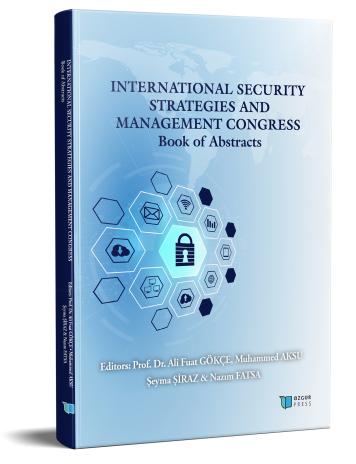
International Security Strategies and Management Congress: Book of Abstracts
Synopsis
The reality that geography shapes the national power elements and strategic destinies of countries is more evident than ever in today’s complex global system. We are passing through an era marked by the transition from hydrocarbon energy to the geopolitics of critical minerals, where terrorism has acquired a "post-modern" character by integrating with technology, and hybrid wars have come to the forefront. Today, the concept of security has broadened and deepened to encompass not only traditional internal and external threats but also human, food, energy, economic, environmental, and cyber security.
These multidimensional challenges necessitate a strategic vision where academic knowledge integrates with field practices. Assuming a pioneering role since 2010 as the first civilian university institution in Turkey to offer postgraduate education in this field to the public bureaucracy, the Gaziantep University Institute of Social Sciences, Department of Security Strategies and Management is organizing the 1st International Congress on Security Strategies and Management with this sense of responsibility. As a first for both our university and our city, this congress aims to comprehensively discuss all dimensions of security through an interdisciplinary approach—ranging from historical security paradigms and digital radicalization to strategic space theories and geopolitical competition in a multipolar system.
Situated at the intersection of geopolitical fault lines in the Middle East and the Eastern Mediterranean, Gaziantep is a city that most deeply feels and manages the political, military, social, and economic repercussions of regional crises. This strategic location makes our city the most natural platform for discussing security policies. Furthermore, within the scope of our congress, a special workshop will be held with the participation of relevant institutions to evaluate how the future of education in security strategies should be structured in light of this expanding security concept.
This book of abstracts in your hands is a concrete reflection of our goal to make a lasting academic contribution to the literature of security sciences. We would like to express our deepest gratitude to the researchers who added value to our congress with their papers, to all the institutions that contributed to the organization, and to our colleagues.
Keywords:
How to cite this book
License

This work is licensed under a Creative Commons Attribution-NonCommercial 4.0 International License.
Published
ISBN
DOI
Statistics
Categories
Copyright (c) 2026 Ali Fuat Gökçe- Muhammed Aksu- Şeyma Şiraz- Nazım Fatsa