
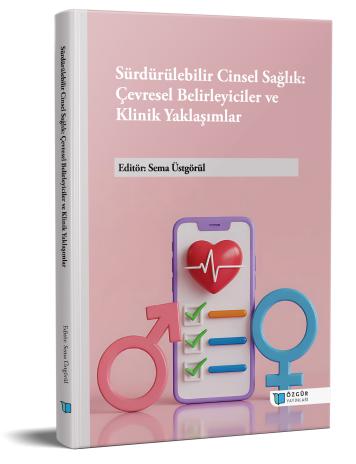
Sustainable Sexual Health in Men: Erectile Dysfunction, Treatment Options and Preventative Approaches
Chapter from the book:
Üstgörül,
S.
(ed.)
2026.
Sustainable Sexual Health: Environmental Determinants and Clinical Approaches.
Synopsis
Sexual health is defined not merely as the absence of disease or dysfunction, but as a state of complete well-being in physical, emotional, mental and social terms. In this context, sexual health is a fundamental determinant in terms of enabling safe and satisfying sexual experiences. In the context of sustainable sexual health, it is emphasised that all individuals, regardless of gender, must have equal access to sexual rights. These rights are not only a key component of sustainable development, but also critically important for improving and enhancing the general health of men, who are often overlooked in the field of sexual and reproductive health. Despite this, it is reported that men have less access to reproductive health services than women. However, it is noted that any irregularity in sexual health can have negative effects not only on physical health but also on psychological well-being. Erectile dysfunction, one of the significant issues affecting male sexual health, is defined as the inability to achieve or maintain a satisfactory erection. This condition, which can cause disruptions in sexual life and partner relationships, can have negative effects on an individual's quality of life. It is reported that the prevalence of erectile dysfunction varies depending on age or other risk factors; it can affect approximately 3% to 76.5% of men. It is stated that the individual's quality of life, partner relationships and general health status can be improved by identifying risk factors, implementing current treatments and adopting preventive approaches. In this context, it is important that erectile dysfunction is addressed with a holistic approach in order to ensure sustainable sexual health.
How to cite this book
License

This work is licensed under a Creative Commons Attribution-NonCommercial 4.0 International License.
Published
DOI
Categories
Copyright (c) 2026 Sema Üstgörül; Sema Üstgörül- İhsan Barış Müldür- Yasemin Yücel- Vasfiye Eroğlu- Sena Cip- Damlagül Acar- Emine Temizkan Sekizler- Seher Öztürk- Burçin Bektaş Pardes- Gülcan Karabulut- Özlem Demirel Bozkurt- Şükran Başgöl- Saadet Karademir