
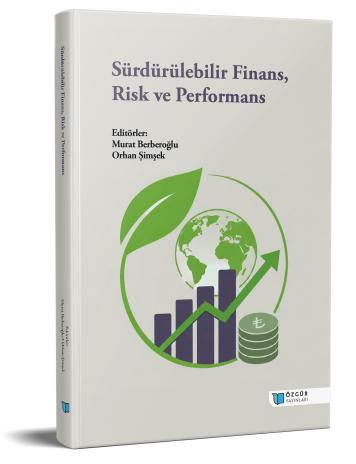
Sustainable Finance, Risk, and Performance
Synopsis
In recent years, financial markets have been reshaped not only by economic variables but also by climate change, energy transition, sustainability policies, geopolitical risks, technological transformation, and evolving societal expectations. As the global significance of the Sustainable Development Goals (SDGs) continues to increase, financial systems have begun to undergo a profound transformation toward a new paradigm centered on environmental, social, and governance considerations. This transformation affects a wide range of areas, extending beyond banking and capital markets to encompass investment decisions, corporate performance, energy policies, and financial inclusion.
This book, entitled “Sustainable Finance, Risk, and Performance”, represents an interdisciplinary academic endeavor that examines the implications of the sustainable finance approach for financial markets from multiple perspectives. As the product of collective scholarly effort, the book addresses a variety of contemporary and significant topics, including sustainable financial literacy, financial inclusion, green banking practices, environmental quality, energy uncertainty, commodity markets, financial performance analysis, corporate risks, investment funds, and alternative organizational models. These issues are explored through both theoretical and empirical approaches.
The chapters included in this book evaluate the relationship between sustainability and finance not only from the perspective of conventional financial indicators but also from the perspectives of environmental risks, corporate resilience, investor behavior, and social sustainability. In this respect, the book aims to serve as a comprehensive resource that brings together current debates and emerging insights for academics, researchers, graduate students, finance professionals, and policymakers.
It is increasingly evident that the future of financial systems will be shaped not solely by the objectives of profitability and economic growth, but also by the principles of sustainability, resilience, and inclusiveness. In this context, our foremost hope is that this book will contribute to the growing body of scholarship in the field of sustainable finance and provide a foundation for future academic research.
We would like to thank all chapter authors for their efforts and valuable contributions to the preparation of this book. We hope that this work will be beneficial to both the academic literature and practitioners.
Chapters
How to cite this book
License

This work is licensed under a Creative Commons Attribution-NonCommercial 4.0 International License.
Published
ISBN
DOI
Statistics
Categories
Copyright (c) 2026 Murat Berberoğlu- Orhan Şimşek; Mehmet Serkan Çalı- Salih Aydın- Uğur Uzun- Murat Berberoğlu- Hasan Ayaydın- Mustafa Uysal- Erhan Daştan- Ceyda Yerdelen Kaygın- Cihan Yılmaz- Adem Ruhan Sönmez- Cengizhan Karaca- Süheyya Alpaslan Bostan- Kübra Saka Ilgın