
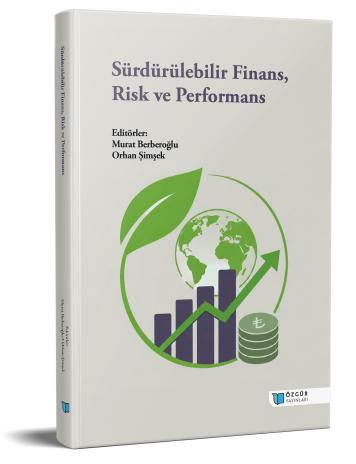
The Impact of Trade Credit Policy on Firm Value: Evidence From the BIST Chemical Sector
Chapter from the book:
Berberoğlu,
M.
&
Şimşek,
O.
(eds.)
2026.
Sustainable Finance, Risk, and Performance.
Synopsis
This study investigates the impact of trade credit policy on firm value among chemical sector firms listed on Borsa Istanbul. To this end, the analysis employs quarterly data for 27 firms operating in the BIST chemical sector during the period from 2015Q1 to 2025Q3. Firm value is proxied by Tobin's Q, whereas trade credit policy is captured through two indicators: the trade receivables-to-net sales ratio and the trade receivables-to-current assets ratio. The empirical analysis first examines the stationarity properties of the variables using the Pesaran CIPS panel unit root test. The effect of trade credit policy on firm value is then estimated using the System Generalized Method of Moments (System GMM) estimator. Furthermore, the dynamic causal relationships among the variables are assessed using the panel Granger non-causality test proposed by Juodis, Karavias, and Sarafidis (2021). The empirical findings show that the trade receivables-to-net sales ratio has a negative and statistically significant effect on firm value, while the share of trade receivables in current assets does not exert a statistically significant effect. In addition, sales growth and firm size are found to enhance firm value, whereas leverage negatively affects firm value.
How to cite this book
License

This work is licensed under a Creative Commons Attribution-NonCommercial 4.0 International License.
Published
DOI
Categories
Copyright (c) 2026 Murat Berberoğlu- Orhan Şimşek; Mehmet Serkan Çalı- Salih Aydın- Uğur Uzun- Murat Berberoğlu- Hasan Ayaydın- Mustafa Uysal- Erhan Daştan- Ceyda Yerdelen Kaygın- Cihan Yılmaz- Adem Ruhan Sönmez- Cengizhan Karaca- Süheyya Alpaslan Bostan- Kübra Saka Ilgın