
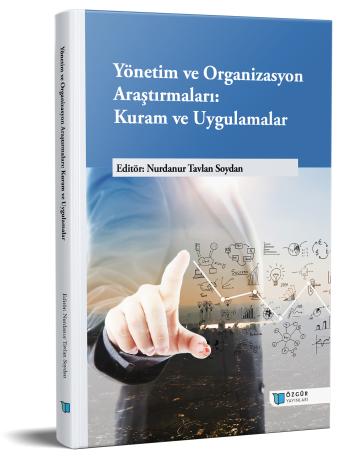
Management and Continuity in Family Companies
Chapter from the book:
Tavlan Soydan,
N.
(ed.)
2026.
Management and Organization Research: Theory and Practice.
Synopsis
This study examines key issues related to the management and continuity of family companies. Family companies are among the most significant contributors to economic development, employment, and entrepreneurship worldwide. However, due to their unique structures resulting from the coexistence of family and business systems, they present both opportunities and challenges. The study primarily addresses the concept and defining characteristics of family companies, highlighting their strengths such as strong commitment, long-term orientation, trust-based relationships, flexibility, and rapid decision-making. It also addresses potential weaknesses such as intrafamily conflicts, nepotism, role ambiguity, resistance to change, and difficulties in institutionalization. To better understand the behavior and management of family companies, the study reviews important theoretical perspectives. These include systems models explaining the interaction between family, business, ownership, and management subsystems; agency theory focusing on conflicts of interest and management mechanisms; stewardship theory emphasizing trust, accountability, and collective commitment; and socio-emotional wealth theory highlighting the importance of non-financial family goals. The study also includes a resource-based view perspective and dynamic capability theory that explain how family-specific resources and talents contribute to competitive advantage and long-term sustainability. Furthermore, the study examines the life cycle of family companies and the managerial challenges that arise at different stages of development. Particular emphasis is placed on continuity, one of the most critical issues faced by family companies. In this context, the importance of clearly separating family and business boundaries, effectively managing intergenerational transfer and succession processes, establishing governance mechanisms such as family councils and family assemblies, and developing a family constitution is discussed. Overall, this study demonstrates that sustainable continuity in family companies depends on striking a balance between family values and corporate (professional) management practices.
How to cite this book
License

This work is licensed under a Creative Commons Attribution-NonCommercial 4.0 International License.
Published
DOI
Categories
Copyright (c) 2026 Nurdanur Tavlan Soydan; Ahmet Sadık Yıldırım- Özüm Eğilmez- Ahu Sezgin- Emrah Köksal Sezgin- Şerife Karagöz- M. Sabri Şirin- Serpil Köse- Mihribar Bilgin- Murat Nazlı- Emine Yılmaz Atik- Muhammet Esat Erdoğan- Rabia Yılmaz