
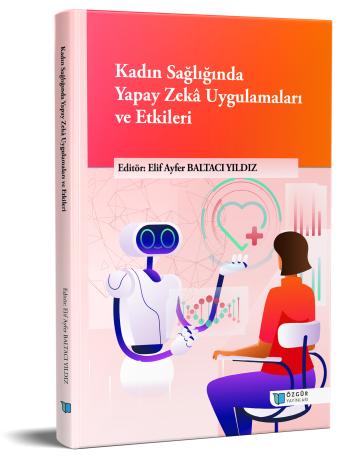
Older Women’s Health and Smart Care Technologies: Current Approaches in Nursing Care
Chapter from the book:
Baltacı Yıldız,
E.
A.
(ed.)
2026.
Applications and Impacts of Artificial Intelligence in Women's Health.
Synopsis
The ageing of the global population has made older women’s health an important field of nursing care in terms of chronic disease management, safe living, home care, social support, and quality of care. Older women may experience multidimensional health and care-related challenges in later life, including chronic diseases, polypharmacy, fall risk, functional limitations, social isolation, and the need for long-term care. In this context, smart care technologies, including smart home systems, wearable devices, environmental sensors, remote patient monitoring, telehealth applications, and artificial intelligence-supported systems, may contribute to monitoring older women’s health status, identifying risks at an early stage, and supporting continuity of care. However, these technologies should not be considered as substitutes for nursing care; rather, they should be viewed as supportive tools that strengthen nursing assessment, patient safety, care coordination, and individualized care planning. Nurses should interpret technological data together with the individual’s clinical condition, living environment, care needs, self-care capacity, and preferences. In addition, privacy, autonomy, data security, digital inequality, and gender-sensitive care principles should be considered in the use of these technologies. In conclusion, smart care technologies have the potential to improve the quality of care in older women’s health; however, their effective and ethical use depends on their integration with nursing care.
How to cite this book
License

This work is licensed under a Creative Commons Attribution-NonCommercial 4.0 International License.
Published
DOI
Categories
Copyright (c) 2026 Elif Ayfer Baltacı Yıldız; Veysel Kızılarslan- Aycan Şahin- Leyla Sezgin- Elif Ayfer Baltacı Yıldız- Şükriye Şahin- Yasemin Özhanlı- Süheyla Demirtaş Alpsalaz- Rukiye Demir Dikmen