
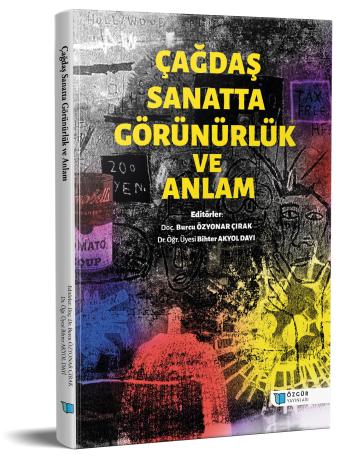
Memory Erosion in Urban Space: A Reading Through Artistic Practices
Chapter from the book:
Akyol Dayi,
B.
&
Özyonar Çırak,
B.
(eds.)
2026.
Visibility and Meaning in Contemporary Art.
Synopsis
This research aims to examine how the phenomenon of memory loss in the city, caused by modernization, migration, urban transformation, and capital-driven construction processes, is addressed within the context of contemporary art. The study investigates how physical spatial changes weaken the historical, cultural, and social bonds that individuals establish with the city, and how this loss is made visible through art. In this context, Istanbul Biennial catalogues published since 2005 were examined through document analysis, and artworks dealing with themes such as urban memory loss, loss of belonging, destruction, and displacement were selected and analyzed. In this regard, the artists critically addressed urban memory loss by employing different materials and techniques. The examined artists explored the effects of urban transformation on memory, identity, and belonging through diverse materials and modes of expression. While Young-jun Tak, Alejandro Almanza Pereda, Bilal Yılmaz, and Rayyane Tabet questioned spatial transformation, destruction, and the erasure of the past, Jonathas de Andrade and Bisan Abu Eisheh made visible the relationship between memory loss and displacement through personal narratives, everyday objects, and archival representations. Rem Koolhaas, Cao Fei, Axel Wieder, Jesko Fezer, and Solmaz Shahbazi, on the other hand, opened up discussions on the effects of modern urbanization on collective memory, identity, and belonging through photography, video, digital media, and urban research. In this respect, all of these artists critically reveal that urban transformation is not merely a physical process, but also a social phenomenon that leads to the loss of memory and identity.
How to cite this book
License

This work is licensed under a Creative Commons Attribution-NonCommercial 4.0 International License.
Published
DOI
Categories
Copyright (c) 2026 Bihter Akyol Dayi- Burcu Özyonar Çırak; Bihter Akyol Dayi- Burcu Özyonar Çırak- Buse Kızılırmak Çekinmez- Şükriye İnan Çalapkulu- Eda Seda Tosun- Gülşah Bayraktar- Gülşah Özdemir- Hatice Doğan- Sara Çebi