
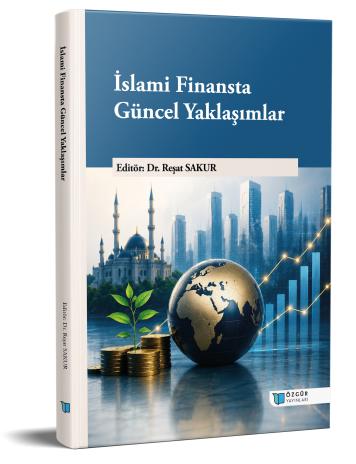
Current Approaches in Islamic Finance
Synopsis
Financial systems are undergoing not only structural but also conceptual transformations under the influence of global economic change. Increasing economic uncertainty, the pursuit of sustainable development goals, rapid digitalization, and the growing emphasis on ethical finance have necessitated the development of new approaches within the discipline of finance. In this evolving landscape, Islamic finance has emerged not merely as an interest-free financial model but as a significant component of the search for a more inclusive and sustainable financial system through its principles of justice, transparency, risk sharing, and close linkage with the real economy.
In recent years, the expansion of participation banking, the growth of sukuk markets, the wider adoption of takaful practices, the emergence of Islamic financial technologies (Islamic FinTech), and the strong convergence between Islamic finance and sustainable finance have underscored the need to reassess both the theoretical foundations and practical applications of Islamic finance. These developments have attracted increasing attention from academics, financial institutions, and policymakers, extending well beyond Muslim-majority countries and positioning Islamic finance as a globally relevant field of study and practice.
This edited volume, Current Approaches in Islamic Finance, has been prepared with the objective of examining these contemporary developments from diverse perspectives and contributing to the ongoing scholarly discourse in the field. The chapters included in this book adopt an interdisciplinary approach to explore a broad range of topics, including the fundamental principles of Islamic finance, participation banking, interest-free financial instruments, capital markets, financial technologies, sustainability, corporate governance, and current practices. Accordingly, the volume aims not only to synthesize the existing body of knowledge but also to inspire future research and enrich academic discussions in this dynamic and rapidly evolving discipline.
We firmly believe that scientific progress is best achieved through collaborative efforts that bring together diverse perspectives on a common intellectual platform. Guided by this understanding, this book has been shaped by the valuable contributions of scholars from different universities and areas of expertise, with the aim of strengthening the connection between theoretical knowledge and practical applications. In this respect, we hope that the volume will serve as a valuable reference for academics, graduate students, finance professionals, participation finance institutions, regulatory authorities, and all readers interested in the field of Islamic finance.
We would like to thank all the chapter authors who contributed to the preparation of this work through their scientific research for their hard work and dedication; we hope that this study will make meaningful contributions to the emerging literature on participatory finance in our country and to the international academic body of knowledge.
Believing that knowledge gains its greatest value when it is shared, we hope that this book will inspire new avenues of research and make a lasting, albeit modest, contribution to the advancement of scholarly work in the field of Islamic finance.
Chapters
How to cite this book
License

This work is licensed under a Creative Commons Attribution-NonCommercial 4.0 International License.
Published
ISBN
DOI
Statistics
Categories
Copyright (c) 2026 Reşat Sakur; Mehmet Murat Şenol- Habatamu Alebachew Legass- Ömer Keskin- Yaşar Alptürk- Tayfun Yılmaz- Serdar Yaman- Mert Baran Tunçel- Metin Seyhan