
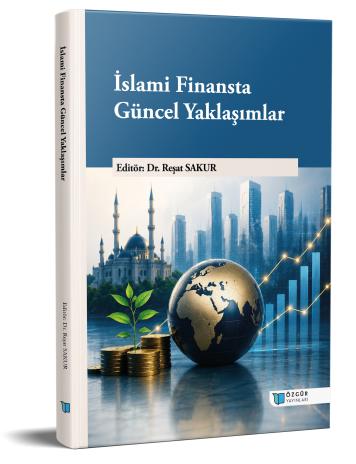
The Impact of Liquidity Management on Firm Value, Investment Decisions, and Bankruptcy Risk: A Study on the Participation Sustainability Index
Chapter from the book:
Sakur,
R.
(ed.)
2026.
Current Approaches in Islamic Finance.
Synopsis
In today’s dynamic market conditions, sustainability and effective liquidity management are of vital importance for enterprises to maintain their competitive advantage and preserve their assets. Accordingly, the primary objective of this study is to determine the direction and magnitude of the impact of liquidity levels (current ratio) on the financial distress risk (Altman Z-Score), real investments (CAPEX), and market value (Market-to-Book Ratio) of 12 firms listed in the BIST Participation Sustainability Index. The analysis utilizes quarterly data spanning the 2015–2025 period, and the obtained financial data were tested using the panel data regression method. The empirical findings demonstrate that an increase in liquidity levels has a positive impact on the Z-Score, thereby mitigating the risk of financial failure and bankruptcy. Conversely, heightened liquidity levels are found to exert a negative effect on both real investments and market value. While the existing literature predominantly focuses on conventional sectors, this study aims to fill a significant gap by simultaneously addressing three fundamental dimensions of corporate finance and focusing on firms that adopt the principles of Islamic finance and environmental/social sustainability. The results provide a novel and profound perspective to the literature by revealing that maintaining high liquidity to minimize bankruptcy risk in ethics- and sustainability-oriented firms creates a significant opportunity cost, which may constrain the firm's growth potential and value maximization. It is recommended that corporate managers reassess their tendency to hold excessive liquidity driven by risk aversion, reallocate idle funds toward value-creating real investments, and establish an optimal liquidity balance. Furthermore, it is a strategic necessity for decision-makers to develop flexible and prudent working capital policies that minimize financial risks while simultaneously maximizing long-term market value.
How to cite this book
License

This work is licensed under a Creative Commons Attribution-NonCommercial 4.0 International License.
Published
DOI
Categories
Copyright (c) 2026 Reşat Sakur; Mehmet Murat Şenol- Habatamu Alebachew Legass- Ömer Keskin- Yaşar Alptürk- Tayfun Yılmaz- Serdar Yaman- Mert Baran Tunçel- Metin Seyhan