
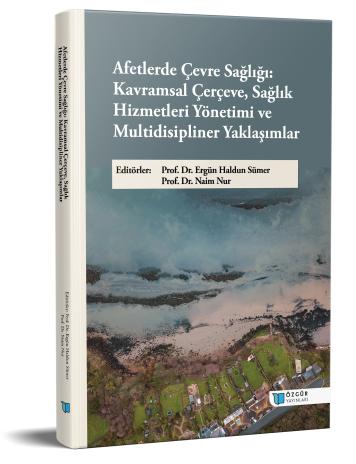
Environmental Health in Shelter and Settlement Areas
Chapter from the book:
Sümer,
E.
H.
&
Nur,
N.
(eds.)
2026.
Environmental Health in Disasters: A Conceptual Framework, Health Services Management, and Multidisciplinary Approaches.
Synopsis
This chapter examines the role of environmental health services in protecting public health within post-disaster sheltering and temporary settlement areas. Disasters frequently disrupt infrastructure systems and negatively affect access to safe drinking water, sanitation services, waste management, energy supply, and healthy housing conditions. In temporary settlements established after disasters, overcrowding, inadequate ventilation, insufficient sanitation, and improper waste disposal increase the risk of waterborne, foodborne, respiratory, and vector-borne diseases. Therefore, environmental health interventions should be considered not only as emergency response activities but also as essential components of sustainable public health management.
The chapter addresses post-disaster assembly areas, temporary sheltering systems, tent-city planning, water supply, sanitation, waste management, ventilation, housing health, ground characteristics, and community participation from an environmental health perspective. In addition, numerical standards used in temporary settlement planning are discussed in detail. International humanitarian guidelines emphasize that minimum living space per person, safe distances between tents, fire safety corridors, toilet and shower capacity, daily water requirements, drainage systems, and accessibility standards are critical for preventing secondary public health problems and maintaining quality of life in temporary settlements.
The study also highlights the importance of national and international disaster management frameworks, including the Disaster and Emergency Management Presidency of Türkiye (AFAD), the Türkiye Disaster Response Plan (TAMP), the Türkiye Disaster Risk Reduction Plan (TARAP), and guidelines developed by Sphere, WHO, and UNHCR. These frameworks provide guidance for the safe, sustainable, and health-oriented management of temporary settlements.
In conclusion, environmentally sustainable and standards-based settlement planning plays a critical role in reducing environmental risks, protecting vulnerable populations, preventing infectious diseases, and supporting post-disaster recovery processes. Community participation and integrated environmental health management are essential for improving resilience and maintaining public health in disaster settings.
How to cite this book
License

This work is licensed under a Creative Commons Attribution-NonCommercial 4.0 International License.
Published
DOI
Categories
Copyright (c) 2026 Ergün Haldun Sümer- Naim Nur; Serkan Çelikgün- İmran Şahin Düz- Sanem Nemmezi Karaca- Naim Nur- Nagehan Ekici Koşaroğlu- Nurcan Bağlam- İrem Akova- Şahin Yıldırım- İbrahim Furkan Sarkım- Zeynep Sümer- Yaşam Deniz- Nuriye Dinç- Yeltekin Demirel- Emre Sarı- Elif Alıcı Bıyık- Veysel Kenan Çelik- Yusuf Kenan Tekin- İlhan Korkmaz- Gülaçan Tekin- Ergün Sümer- Gülay Yıldırım- Sema Merve Sümer- Ferdağ Yıldırım