
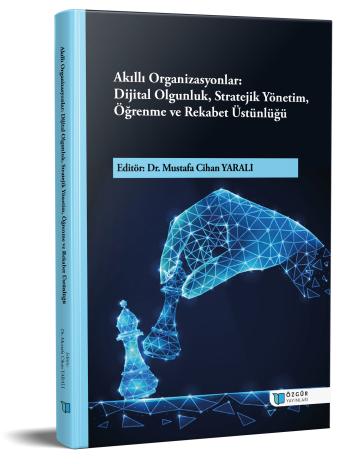
A Critique of the Smart Organization Discourse: Assumptions, Limitations, and Organizational Outcomes of Digital Maturity Models
Chapter from the book:
Yaralı,
M.
C.
(ed.)
2026.
Smart Organizations: Digital Maturity, Strategic Management, Learning, and Competitive Advantage.
Synopsis
This study examines the concept of the smart organization within the framework of digital maturity models, critically analyzing their assumptions, limitations, and organizational consequences. The introduction emphasizes that digital transformation is not merely a technological process, but a multidimensional field encompassing strategic and organizational restructuring. The second chapter addresses the conceptual foundations of digital maturity models, noting that they are largely based on the assumption of incremental and linear development. The third chapter critiques these assumptions, questioning technological determinism, the claim of universality, and the linear relationship between performance and success. The fourth chapter demonstrates that digital maturity models do not adequately consider organizational context, power relations, and meaning-making processes. The fifth chapter discusses the potential organizational consequences of these models, such as strategic blindness, adaptive behavior, and the pursuit of legitimacy. The conclusion emphasizes the need to rethink the concept of the smart organization not only from a technology-based perspective but also from a contextual, human-centered, and critical one. While acknowledging the significant analytical contributions of digital maturity models, the study also highlights the importance of not ignoring their limitations.
How to cite this book
License

This work is licensed under a Creative Commons Attribution-NonCommercial 4.0 International License.
Published
DOI
Categories
Copyright (c) 2026 Mustafa Cihan Yaralı; Gözde Sunman- Mehtap Aracı Kazıcı- Dilek Özdoğan- Tarık Karamolla- Şükran Oruç- Pınar Duygu Akın- Kenan Orçanlı- Semra Köse- Gönül Gül- Gürhan Yanık- Evren Arı