
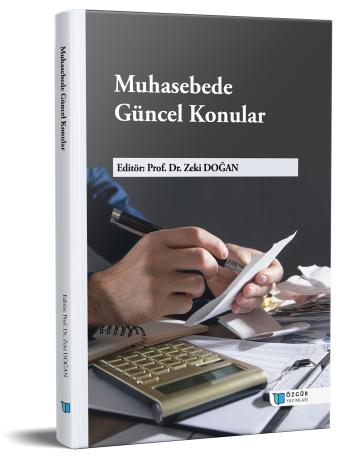
Notes to Financial Statements within the Framework of Accounting and Financial Reporting Standards: Problems, Discussions, and Research Areas
Chapter from the book:
Doğan,
Z.
(ed.)
2026.
Current Issues in Accounting.
Synopsis
Notes to financial statements are among the important information areas within the financial reporting system, as they explain and complement the primary financial statements and contribute to users’ more accurate interpretation of financial information. However, in light of recent developments in financial reporting, issues such as excessive disclosure burden, boilerplate expressions, ineffective application of the materiality principle, readability and understandability problems, and disclosures disconnected from user needs have led notes to financial statements to be reconsidered in terms of decision usefulness. In this context, TFRS 18: Presentation and Disclosure in Financial Statements, published by the Public Oversight, Accounting and Auditing Standards Authority (KGK) within the framework of the Turkish Financial Reporting Standards (TFRS) and adapted from the International Financial Reporting Standards (IFRS) developed by the International Accounting Standards Board (IASB), represents an important transformation process aimed at achieving more effective communication, better-structured disclosures, and more comparable financial information in financial reporting. Within the scope of this transformation process, this study examines notes to financial statements from a conceptual and critical perspective within the framework of accounting and financial reporting standards. In the study, literature review, standard texts, and current regulatory approaches were considered together, and the main problems, discussions, and research areas related to notes and disclosures were addressed. The findings indicate that the main discussions and research areas concerning notes to financial statements are shaped not only around compliance with standards, but also around issues such as entity-specific disclosures instead of boilerplate expressions, readability and understandability, new disclosure areas focused on digitalization and sustainability, as well as audit quality and professional judgment.
How to cite this book
License

This work is licensed under a Creative Commons Attribution-NonCommercial 4.0 International License.
Published
DOI
Categories
Copyright (c) 2026 Zeki Doğan; Abitter Özulucan- Abdulkerim Daştan- Eda Köse- İsmail Bekci- Ergin Temel- Hakan Seldüz- Adalet Zozik- Ersin Timur- Burhan Günay- Meryem Uslu- İpek Yaylalı- Sevim Ağaç- Ayşe Gül Gök- M. Yılmaz İçerli