
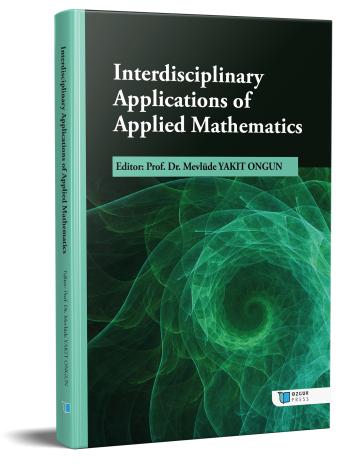
Applied Mathematics in Mental Health: A Game-Theoretic Perspective on Psychological Symptoms
Chapter from the book:
Yakıt Ongun,
M.
(ed.)
2026.
Interdisciplinary Applications of Applied Mathematics.
Synopsis
For decades, psychological symptoms have primarily been interpreted as indicators of dysfunction and pathology. However, recent developments in evolutionary psychiatry, mathematical psychology, and computational modeling suggest that certain symptoms may also be understood as adaptive responses to environmental challenges. This chapter examines mental health through the lens of game theory and proposes that many psychological symptoms can be conceptualized as equilibrium strategies emerging from interactions between individuals and their environments. Anxiety, social anxiety, depression, obsessive-compulsive behaviors, and post-traumatic stress responses are analyzed as strategic adaptations shaped by costs, benefits, uncertainty, and risk management. Particular attention is given to Nash equilibrium as a framework for understanding the persistence of apparently maladaptive behaviors. The chapter further argues that psychotherapy and psychiatric interventions may be interpreted as processes that alter payoff structures rather than merely suppress symptoms. By integrating applied mathematics with contemporary psychological theory, the chapter offers a novel perspective on the origins, maintenance, and treatment of psychological symptoms.
How to cite this book
License

This work is licensed under a Creative Commons Attribution-NonCommercial 4.0 International License.
Published
DOI
Categories
Copyright (c) 2026 Mevlüde Yakıt Ongun; Mehmet Kocabıyık- Halil İbrahim Dönmez- Mehmet Onur Olgun- Sırma Zeynep Alparslan Gök- Çağnur Çörekli- Hatice Bulut Demiralay- Mehmet Uc- Fatih Rıza Çelik- Mevlüde Yakıt Ongun- Ceren Uysal- Fatma İşcan