
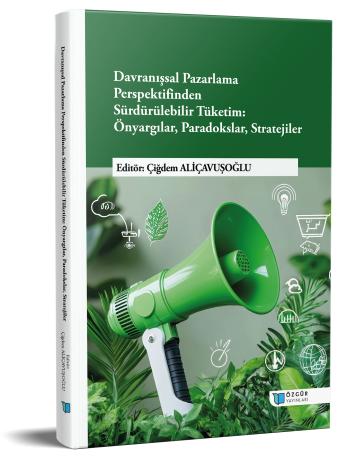
Sustainable Consumption: A Conceptual Framework and Contemporary Debates
Chapter from the book:
Aliçavuşoğlu,
Ç.
(ed.)
2026.
Behavioral Marketing Perspectives on Sustainable Consumption: Biases, Paradoxes, and Strategies.
Synopsis
Sustainable consumption has emerged as an increasingly important multidimensional concept in response to global challenges such as climate change, biodiversity loss, natural resource depletion, and the growing generation of waste. This chapter revisits the conceptual foundations of sustainable consumption and examines its environmental, economic, and social dimensions through a holistic perspective. First, the origins, key definitions, and contemporary position of sustainable consumption within the academic literature are discussed. Subsequently, the chapter explores why sustainable consumption has become a critical field of research and policy by focusing on current issues including climate change, food waste, electronic waste, and the intensification of resource use.
A central focus of the chapter is the attitude–behavior gap, which refers to the discrepancy between individuals’ pro-environmental attitudes and their actual consumption practices. In this context, the psychological, economic, cultural, and structural factors influencing sustainable consumption behaviors are analyzed, highlighting that sustainability cannot be adequately explained solely through individual awareness and responsibility. Furthermore, the chapter examines the circular economy as an alternative to conventional linear production and consumption systems, addressing both its opportunities and its limitations in promoting sustainability.
Finally, the role of trust in sustainable consumption is discussed through the lens of environmental labels, certification schemes, and greenwashing practices. Particular attention is given to the ways in which misleading environmental claims can undermine consumer confidence and hinder the adoption of sustainable consumption behaviors. The chapter argues that sustainable consumption should be understood not only as a matter of individual consumer choice but also as a phenomenon shaped by public policies, institutional arrangements, technological transformations, and broader societal value systems. In this regard, sustainable consumption is presented as a comprehensive transformation framework that integrates environmental protection, social well-being, and economic sustainability.
How to cite this book
License

This work is licensed under a Creative Commons Attribution-NonCommercial 4.0 International License.
Published
DOI
Categories
Copyright (c) 2026 Çiğdem Aliçavuşoğlu; Çiğdem Aliçavuşoğlu- Murat Aksu- Özgür Kuru- Candan Özgün Ayar- Halime Büşra Yaşar- Muhammed Furkan Tan- Taner Eken