
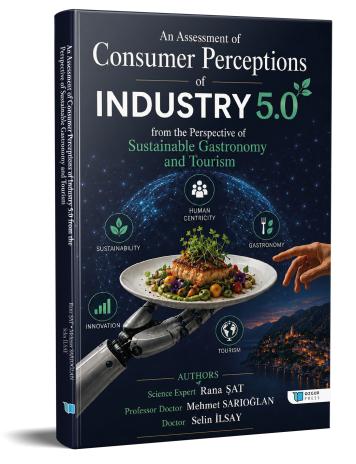
An Assessment of Consumer Perceptions of Industry 5.0 from the Perspective of Sustainable Gastronomy and Tourism
Synopsis
This book aims to evaluate the effects of the Industry 5.0 approach on consumer perception within the context of sustainable gastronomy and tourism. Industry 5.0 shifts Industry 4.0’s technology-centric approach to a more ethical, social, and environmental foundation based on the principles of human-centeredness, sustainability, and resilience. The gastronomy and tourism sectors are among the areas where this transformation is most visibly taking place.
The study examines the impacts of Industry 5.0 on the gastronomy sector within the framework of artificial intelligence, robotic systems, big data, the Internet of Things, augmented reality, virtual reality, blockchain, digital twins, and smart kitchen systems. Additionally, the study addresses sustainable gastronomy, food waste, local supply chains, the circular economy, consumer trust, technology acceptance, perceived value, satisfaction, and loyalty relationships. This study aims to evaluate the psychometric properties of a scale designed to measure how consumers perceive Industry 5.0 technologies within the context of sustainable gastronomy and tourism. A 30-item five-point Likert-type scale was used in the study; data were collected from 406 participants. Following data cleaning procedures, analyses were conducted on 398–405 valid observations, depending on the approach applied. Sample adequacy was assessed using the Kaiser-Meyer-Olkin (KMO = 0.75) measure and Bartlett’s sphericity test (p < 0.001), and the dataset was determined to be suitable for factor analysis. Exploratory factor analysis was conducted using two complementary approaches: an eight-dimensional exploratory structure obtained through principal axis factor analysis on the full scale and Varimax rotation, and a more robust and interpretable four-factor structure comprising 18 items resulting from the elimination of problematic items. These four dimensions were named Robotics and Autonomy, Data, Cloud, and Analytics, Immersive and Smart Technologies, and Digital Services and Production.
Confirmatory factor analysis revealed that the four-factor measurement model fits the data well (χ²/df = 1.41; CFI = 0.95; TLI = 0.94; RMSEA = 0.045). Cronbach’s alpha and composite reliability (CR) values for the dimensions ranged from 0.70 to 0.84. Although the average variance explained (AVE) values were slightly below the 0.50 threshold in most dimensions, discriminant validity was supported according to the Fornell-Larcker criterion. The findings indicate that the original 30-item structure does not constitute a robust measurement model on its own; however, the refined 18-item four-factor structure provides a valid and defensible measurement tool suitable for use at the thesis and journal article levels. The study contributes by revealing the multidimensional nature of consumer perceptions regarding Industry 5.0 technologies in the tourism and gastronomy sectors and by providing a methodological foundation for future scale development studies.
The book offers a conceptual and methodological framework for understanding consumers’ perceptions of sustainable gastronomy and Industry 5.0 applications. In this regard, the study aims to contribute to academics, researchers, tourism and gastronomy businesses, policymakers, and sustainability-focused entrepreneurs.
How to cite this book
License

This work is licensed under a Creative Commons Attribution-NonCommercial 4.0 International License.
Published
ISBN
DOI
Statistics
Categories
Copyright (c) 2026 Selin İlsay- Rana Şat- Mehmet Sarıoğlan