
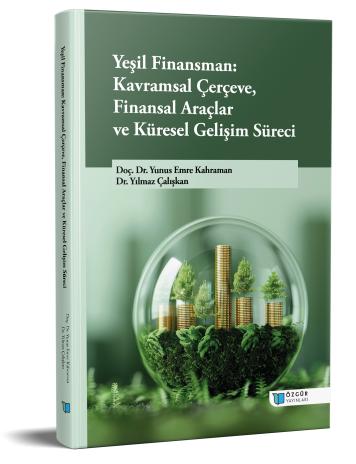
Green Finance: Conceptual Framework, Financial Instruments, and the Global Development Process
Synopsis
Climate change, environmental degradation, the rapid depletion of natural resources, and the potentially irreversible pressures placed on ecosystems have made it necessary to fundamentally rethink not only environmental policies but also the functioning of economic and financial systems. The traditional financial system, which for many years externalized environmental costs in pursuit of economic growth, is now undergoing a new transformation centered on sustainability. At the heart of this transformation lie the concepts of green finance and green capital.
Green finance encompasses the financial instruments, policies, and market mechanisms aimed at supporting investments that generate environmental benefits, combating climate change, facilitating the transition to a low-carbon economy, and preserving natural capital. In this respect, green finance is not merely an environmentally responsible financing approach; it also holds strategic importance for strengthening financial stability, redefining risk management, and ensuring long-term economic resilience.
This book aims to examine the conceptual foundations, financial instruments, and global historical development of green finance from a holistic perspective. The concepts of green finance and green capital are comparatively examined within the frameworks adopted by various international institutions and academic approaches, while the objectives of green finance are evaluated in detail across their environmental, economic, and social dimensions. Furthermore, a broad range of financial instruments—from green bonds and sustainability-linked financial instruments to nature-linked securities and biodiversity funds—is discussed together with their advantages and potential risks.
The book examines the global transformation of green finance from a historical perspective and presents, within a chronological framework, the roles played by the United Nations, the European Union, the World Bank, the European Investment Bank, and international capital market organizations in this field. Spanning from the 1960s to the present day, this historical process demonstrates how green finance has become institutionalized, evolved into a mainstream component of financial markets, and become integrated with the Sustainable Development Goals.
The primary objective of this work is to approach green finance not merely as a normative environmental policy instrument, but also as a paradigm that transforms the structure of financial markets, reshapes investment decisions, and seeks to establish a balance between economic growth and environmental sustainability. In this respect, the book serves as a comprehensive reference for undergraduate and graduate students, academics, policymakers, finance industry professionals, and researchers working in the field of sustainability.
Ultimately, by bringing together the theoretical foundations and practical applications of green finance, this work seeks to make an academic contribution to discussions on the development of a sustainable financial system. The effective implementation of green finance is expected to play a decisive role not only in addressing today’s environmental challenges but also in leaving a livable world for future generations.
How to cite this book
License

This work is licensed under a Creative Commons Attribution-NonCommercial 4.0 International License.
Published
ISBN
DOI
Statistics
Categories
Copyright (c) 2026 Yunus Emre Kahraman- Yılmaz Çalışkan