
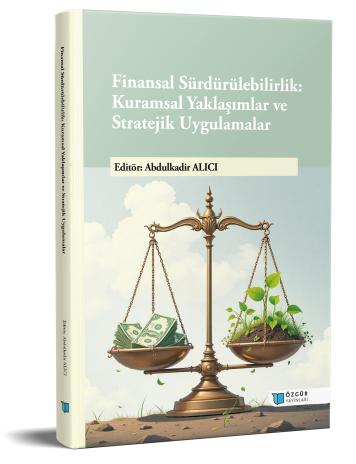
Financial Sustainability Strategies
Chapter from the book:
Alıcı,
A.
(ed.)
2025.
Financial Sustainability: Theoretical Approaches and Strategic Applications.
Synopsis
Globally, environmental pollution, global warming, resource scarcity, and inefficient use of resources are among the most significant obstacles to sustainable development. Industrialization, rapid urbanization, and increasing energy demand accelerate global warming and deepen the climate crisis by increasing greenhouse gas emissions in the atmosphere. Furthermore, the limited availability of basic resources, such as water, energy, and raw materials, combined with current consumption patterns, exacerbates the problem of resource scarcity. In the past, many international agreements have been signed to protect ecosystems and ensure environmental sustainability. The primary purpose of these agreements is to prevent environmental degradation, promote the sustainable use of natural resources, and combat climate change on a global scale. Business activities play a significant role in exacerbating environmental problems on a worldwide scale. In particular, production- and consumption-oriented economic activities, which have increased rapidly since the Industrial Revolution, have led to the overuse of natural resources, increased greenhouse gas emissions, and the degradation of ecosystems. Companies contribute directly or indirectly to environmental pollution through their energy use, waste production, fossil fuel consumption, and supply chain processes. In this context, structuring business activities in line with sustainability principles is emerging as a critical requirement for minimizing environmental impacts. Sustainable finance is an approach that considers not only economic gains but also environmental, social, and governance (ESG) factors when making financial decisions in businesses. Having a financial sustainability strategy is crucial for a company's long-term success and competitive strength. These strategies aim to improve not only the economic profitability of companies but also their environmental and social performance. In this context, the study concludes that businesses must align their financial sustainability strategies with environmental goals to support international agreements aimed at preventing environmental pollution (the Kyoto Protocol, the Paris Climate Agreement).
How to cite this book
License

This work is licensed under a Creative Commons Attribution-NonCommercial 4.0 International License.
Published
DOI
Categories
Copyright (c) 2025 Abdülkadir Alıcı; Abdülkadir Alıcı- Sevim Yılmaz- Ayşe Susuz- İbrahim Karaaslan- Ayşegül Karadavut- Yahya Sönmez- Cemre Körmeçli- Aysena Kedersiz- Gökçen Köroğlu