
Laissez-Faire Leadership
Chapter from the book:
Oktaysoy,
O.
&
Elkırmış,
Ö.
(eds.)
2025.
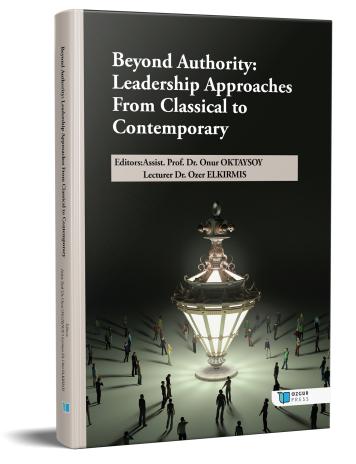
Beyond Authority: Leadership Approaches From Classical to Contemporary.
Synopsis
In today's turbulent, chaotic, and intensely competitive environment, if you take on the responsibility of leading an organization, you need to have highly developed skills that are open to change and further development. Organizations no longer carry the old traditional organizational structures, nor do employees carry the old employee profile. The cumulative speed of the technological changes that mark our age makes tomorrow much more change-prone than today, and there is a need for leaders who can anticipate these changes, interpret them correctly, and respond to them quickly. As it is known, leadership is still not understood by many circles. In particular, the fact that there are hundreds of definitions of leadership in the management literature, the abstract and minimal differences between the many types of leadership defined, and the difference in the understanding of leadership between leaders and followers cause the subject to be more difficult to understand. In this part of the book, laissez-faire leadership is discussed, and its definition, characteristics, effects on followers and organizations, advantages, and disadvantages are given.
How to cite this book
License

This work is licensed under a Creative Commons Attribution-NonCommercial 4.0 International License.
Published
DOI
Categories
Copyright (c) 2025 Onur Oktaysoy- Özer Elkırmış; Erdogan Kaygın- Mustafa Altıntaş- Mehmet Selman Kobanoğlu- Ali Bayram- Selen Uygungil-Erdoğan- Yaşar Şahin- Burcu Turan Torun- Ethem Topçuoğlu- Erdi Bozkır- Talip Bektaş- Vurgun Topçuoğlu- Serdal Özkes- Onur Oktaysoy- Özer Elkırmış- M. Akif Yenikaya- Ebru Uluçay Bektaş- Bilal Kobanoğlu- Mahmut Özdemirkol