
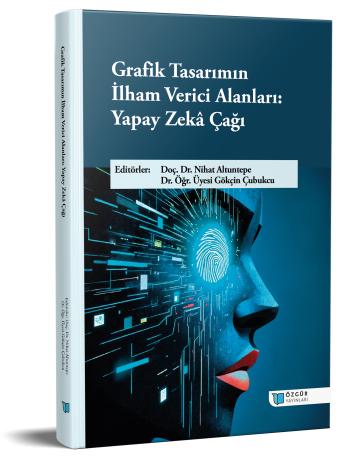
Inspiring Fields of Graphic Design: The Age of Artificial Intelligence
Synopsis
In today’s world, graphic design is no longer merely an aesthetic field of production; it has evolved into a multifaceted discipline intertwined with technology, culture, communication, and human experience. This new era, shaped by rapid digital transformation and the increasing integration of artificial intelligence technologies into everyday practices, redefines the roles, responsibilities, and modes of production of designers. By addressing the intellectual, aesthetic, and technological dimensions of design, all contributing authors provide the opportunity to interpret not only the present but also the future of the discipline. The book you hold offers a comprehensive, critical, and inspiring framework for students, researchers, and all readers interested in understanding design practices, enabling them to grasp, discuss, and develop new perspectives on the transformation emerging in the field of graphic design.
Within this extensive work, the transformation of graphic design in the age of artificial intelligence is examined through six chapters from a multidimensional perspective:
The first chapter explores how the post-digital era reshapes the identity of the designer, revealing that rather than disappearing during historical ruptures, the designer figure continually evolves—taking on the role of a “conceptual mediator” and “cultural interpreter” in the contemporary context.
The second chapter focuses on issues of originality by highlighting the distinction between style and stylization in AI-assisted visual production. It critically examines how AI-generated visuals can move beyond the repetitive patterns inherited from training datasets to achieve a truly creative identity.
The third chapter discusses the role of generative AI in graphic design education, examining the opportunities it offers as a tool that supports students’ creative potential, generates alternative solutions, and enriches studio practices within learning environments.
The fourth chapter reviews the use of artificial intelligence in motion graphics, providing an in-depth assessment of evolving workflows, production processes, and the professional debates arising within the fields of media and communication.
The fifth chapter approaches the relationship between design and technology from both historical and conceptual perspectives, evaluating the impact of technological advancements on design processes, the transformation of business models, and the new avenues for creativity emerging within human–technology interaction.
The sixth and final chapter focuses on the theoretical impact of artificial intelligence on graphic design, emphasizing the indispensable role of the human designer—particularly in intuition, cultural context, and meaning-making processes. The chapter suggests that a hybrid model of human–machine collaboration is inevitable for the future of design.
We sincerely thank all researchers who contributed to the creation of this valuable work. We hope that readers will draw inspiration from the perspectives presented here and illuminate their own creative journeys.
We wish you an engaging and inspiring reading experience.
Editors
Assoc. Prof. Dr. Nihat Altuntepe
Asst. Prof. Dr. Gökçin Çubukcu
How to cite this book
License

This work is licensed under a Creative Commons Attribution-NonCommercial 4.0 International License.
Published
ISBN
DOI
Statistics
Categories
Copyright (c) 2025 Nihat Altuntepe- Gökçin Çubukçu