
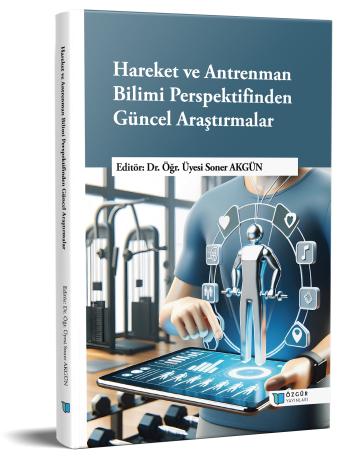
Movement and Training Science in Basketball Players: The Physical and Physiological Demands of Basketball
Chapter from the book:
Akgün,
S.
(ed.)
2025.
Current Research from the Perspective of Exercise and Training Science.
Synopsis
Basketball is a multidimensional sport that integrates high-intensity sprints, rapid changes of direction, jumps, physical contact, and complex decision-making processes. Due to this dynamic nature, player performance depends not only on technical skills but also on movement efficiency, energy system adaptations, and neuromuscular capacity. Movement science enables the analysis of athletes in terms of biomechanical alignment, motor control, joint stability, and kinetic/kinematic parameters, while training science focuses on systematically developing the strength, speed, endurance, and plyometric adaptations required to support these demands. In modern basketball, a holistic integration of these two fields has become increasingly important to optimize performance and reduce injury risk. Today, technologies such as force platforms, IMU sensors, GPS/LPS-based tracking systems and muscle oxygenation (NIRS) monitoring tools allow for precise observation of athletes loading profiles and physiological responses. This chapter explains the fundamental principles of movement and training science in basketball, discussing biomechanical parameters, physiological adaptations, training models, load management, fatigue monitoring, performance analysis, and injury prevention strategies in light of current scientific evidence. Additionally, it addresses physiological differences between male and female basketball players and examines the contrasting profiles of youth and elite athletes.
How to cite this book
License

This work is licensed under a Creative Commons Attribution-NonCommercial 4.0 International License.
Published
DOI
Categories
Copyright (c) 2025 Soner Akgün; Akan Bayrakdar- Emre Karaduman- Cengiz Ölmez- Halit Şar- Burakhan Aydemir- Doğa Comba- Çağlar Edis- Aysu Velimahmutoğlu- Cemrehan Gürler- Hamit Cihan- Abdullah Çetindemir- Bahadır Altay