
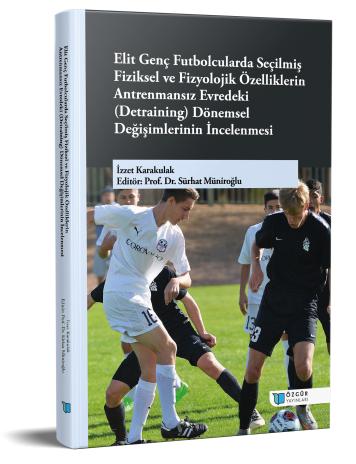
Investigation of Seasonal Changes in Selected Physical and Physiological Characteristics of Elite Youth Soccer Players in Detraining Period
Synopsis
This study was aimed to investigate the periodical changes in selected physical and physiological characteristics of young soccer players in detraining period.Seventeen well-trained young football players from the U-19 team of a professional soccer team participated to this study volunteered (Age: 17,75±0,67 years, Height: 176,17±6,46 cm, Body weight: 69,70±8,16 kg). Tests were repeatedly applied at intervals to determined the body composition, strength, speed, agility, balance, flexibility and endurance characteristics of participants during the competition and after-season detraining. In this study; first measurement was aplied 3 days before the last match of the first competition period, 2nd measurement was realised at the return from short-term (10-day) untrained period in half-season break, 3rd measurement was realised 3 days before the last game of the season, and then 4th, 5th, 6th measurements were realised at 15 day intervals in off-season period.The implementation of these tests took 2 days because of the time required for full recovery between tests. First day morning, on an empty stomach; body composition measurements were realised. After that flexibility measurement, balance measurement, vertical jump measurement, 30-meter sprint test, Arrowhead agility test, and Yo-Yo IRT 2 test were applied in the evening. The second day; RAST Running-based anaerobic sprint test was applied. SPSS (Ver. 22) analysis program was used in the analysis of the data.The normality distribution of the data from the short-term non-training period between the cycles was examined using the "One-sample Kolmogorov-Simirnov Test". Normal distribution data were compared using the Paired-Samples T Test. Non-normal distribution data were compared using nonparametric Wilcoxon test. Repeated measurement data with a normal distribution, which belong to the end of the season for a long period of non-training, was evaluated using "One-way ANOVA for Repeated Measurements". The data with no normal distribution were evaluated using "Friedman Analysis of Variance in Repeated Measurements". For all statistical methods, the level of error (α) was accepted as 0. 05.There were statistically significant negative difference between participants’ 10 m, 20 m and 30 m sprint times and also maksimal oxygen consumption in short-term (10-day) untrained period in half-season break (p<0,05). There were no statistically significant differences for body mass, body fat percentage, agility test, vertical jumps, flexibility test, balance test and RAST fatigue index, maximum and average power parameters (p>0, 05). At the end of the 45-day period without training, there were no statistically significant differences in body fat percentage, flexibility, 30 m and balance performance (p> 0, 05). Statistically significant positive difference was found in the 10 m sprint performance at the end of the 15-day untrained period (p<0. 05). At the end of the 30-day period without training, there were statistically significant negative difference in maksimal oxygen consumption and maximum and average power (p<0,05). At the end of the 45-day period without training, there were statistically significant negative difference in body mass, 10 m sprint performance, agility performance and vertical jumps, and also there was statistically significant pozitive difference in fatigue indeks (p<0,05).As a result; the detraining period should not be completely inactivated in order to minimize the deterioration of the physical and motoric characteristics, especially after a long detraining period. And to make the athlete more ready for the new season, it should be supported with the designed training plans taking into account "detraining-related deceleration time for each physical and motoric characteristic" determined in this study.
How to cite this book
License

This work is licensed under a Creative Commons Attribution-NonCommercial 4.0 International License.
Published
ISBN
DOI
Statistics
Categories
Copyright (c) 2025 İzzet Karakulak; Recep Sürhat Müniroglu