
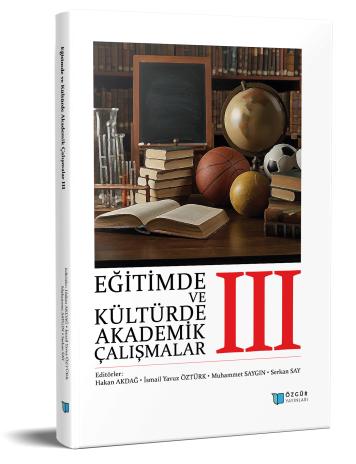
Academic Studies in Education and Culture III
Synopsis
“Academic Studies in Education and Culture III”, is an interdisciplinary edited volume that brings together recent studies examining the increasingly strong ties between education and culture in the information society within the framework of “Cultural Reproduction in the Age of Artificial Intelligence and Digital Media.” It offers a broad thematic spectrum ranging from curricula and textbooks to AI integration; from cultural heritage, identity, and diplomacy debates to sustainability, water and disaster literacy, and values education. These themes are discussed holistically across contexts such as social studies, history, science and mathematics education, special education, Turkish language teaching (including Turkish as a foreign language), teacher education, and education policy.
A significant part of the volume connects education with a sustainable world perspective: by analyzing social studies textbooks and EBA (the Educational Informatics Network) content in terms of sustainability literacy and by presenting examples such as local government–NGO collaborations, environment-based student activities, and water supply projects, it demonstrates how curricula, instructional materials, and local practices can be aligned. Another major focus is rethinking education in relation to AI and digital transformation. Through topics such as teachers’ AI literacy and technostress, AI-supported learning, life skills, entrepreneurship in primary education, game-based learning within the “Maarif Model,” STEM integration, and the effects of realistic mathematics education on creative thinking and mathematical literacy, the book explores how both teacher roles and teaching–learning processes are changing. In language education and translation, it also addresses the usability of AI-generated texts, comparative curriculum perspectives, and the opportunities and limits of digital tools in literary translation.
The volume further deepens discussions of cultural reproduction through historical and cultural studies. Contributions spanning rituals, the history of educational thought, comparisons between the Village Institutes’ applied education model and 21st-century AI-supported learning models, visions for the Turkic world, and archival/document-based research and cultural diplomacy cases reveal the continuity of the education–culture relationship. Overall, the book positions AI not as a substitute for education, but as a supportive element that can enrich learning when integrated in a balanced manner grounded in ethical principles, a human-centered approach, and local needs. By building strong bridges between theory and practice, these studies aim to provide evidence-based recommendations for researchers, teachers, and policymakers, contributing to a more equitable, accessible, and sustainable future in education and culture.
How to cite this book
License

This work is licensed under a Creative Commons Attribution-NonCommercial 4.0 International License.
Published
ISBN
DOI
Statistics
Categories
Copyright (c) 2025 Hakan Akdağ- İsmail Yavuz Öztürk- Muhammet Saygın- Serkan Say