
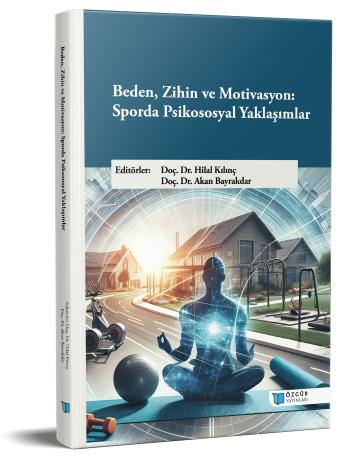
Stress, Flow, and Mindfulness in Sports
Chapter from the book:
Kılınç,
H.
&
Bayrakdar,
A.
(eds.)
2026.
Body, Mind, and Motivation: Psychosocial Approaches in Sport.
Synopsis
In the context of sport, stress cannot be evaluated as a unidimensional negative factor that necessarily impairs performance; rather, it is conceptualized as a multidimensional adaptation process shaped through the interaction of individuals’ cognitive appraisals, recovery resources, and environmental conditions. Stressors experienced by athletes and coaches are understood to exert significant influences on psychological well-being, health, and performance, and these effects appear to be associated not merely with the intensity of stress but with how stress is perceived and regulated. The aim of this book chapter is to examine the relationships among stress, mindfulness, and flow experience in the context of sport within the framework of the theoretical and empirical literature, and to discuss the role of these processes in athletic performance and psychological well-being. The chapter reviews the theoretical foundations and sources of stress in sport settings, as well as the psychological and physiological effects of stress for both athletes and coaches. In addition, it examines the role of mindfulness-based approaches in stress regulation and performance, as well as the psychological and neurobiological foundations of the flow experience. Findings from the literature indicate that mindfulness practices support attentional regulation, bodily awareness, emotion regulation, psychological flexibility, and coping skills among athletes. Moreover, mindfulness-based interventions have been shown to reduce competitive anxiety, burnout, and perceived stress, and to be associated with positive outcomes in psychological well-being, self-efficacy, flow experience, and performance consistency. The flow experience is described as an optimal performance state associated with attentional control, cognitive clarity, and emotional balance, and neurobiological evidence also suggests that this experience is linked to specific neural and physiological patterns. It is suggested that integrating mindfulness-based interventions with practices such as psychological skills training and performance profiling may contribute to more comprehensive intervention models that support athletes' performance development and psychological resilience. In conclusion, effective interventions in sport psychology should aim not only to enhance performance but also to promote sustainable well-being and long-term psychophysiological health.
Keywords:
How to cite this book
License

This work is licensed under a Creative Commons Attribution-NonCommercial 4.0 International License.
Published
DOI
Categories
Copyright (c) 2026 Hilal Kılınç- Akan Bayrakdar; Halil Orbay Çobanoğlu- Abdullah Yüksel- Muhammed Yavuz Kılınç- Akan Bayrakdar- Hilal Kılınç- Zeynep Ayça Terzioğlu