
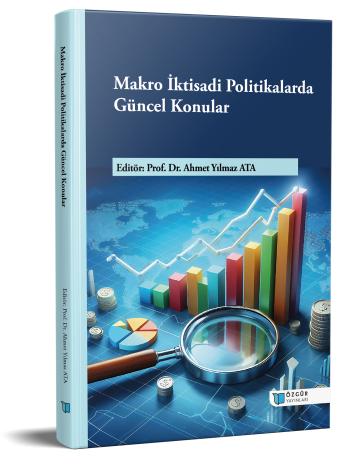
Organic Plant Product Exports in Türkiye and Regional Opportunities: An Assessment of the Mediterranean and Aegean Regions
Chapter from the book:
Ata,
A.
Y.
(ed.)
2026.
Current Issues in Macroeconomic Policies.
Synopsis
This study, evaluates the economic contributions of organic plant product exports in Türkiye and the regional opportunities emerging specifically in the Aegean and Mediterranean regions. Organic agriculture has become an increasingly significant production model in terms of environmental sustainability, food safety, rural development, and the generation of added value in international trade. Within this framework, the study addresses organic plant product exports not merely as a foreign trade activity, but also as a strategic economic field that supports regional development. The chapter first summarizes the concept of organic products, certification, packaging, labeling, transportation, and storage processes; it then examines the development of organic agricultural production and the organic product market both globally and in Türkiye. From Türkiye’s perspective, organic plant product exports have the potential to generate foreign exchange income, improve quality standards in agricultural production, support rural employment, increase producer income, and enhance the competitiveness of local economies. The Aegean Region stands out as a production area with high export value through products such as organic olives, olive oil, grapes, figs, and dried fruits. The Mediterranean Region, on the other hand, offers significant export opportunities in products such as citrus fruits, fresh fruits and vegetables, olives, and medicinal and aromatic plants. When these product groups are evaluated together with regional climatic conditions, production experience, and foreign market demand, they provide important advantages that may increase Türkiye’s organic export capacity. In addition, strengthening regional specialization, branding, and cooperative organization processes may contribute to the more balanced and sustainable development of export performance. The chapter also addresses key challenges such as certification costs, producer organization, logistics infrastructure, product standardization, and competitive conditions in foreign markets. In conclusion, the study reveals that organic plant product exports constitute a strategic field for the Turkish economy and that development in this field should be strengthened through sustainable production policies, institutional support mechanisms, and regional planning approaches.
How to cite this book
License

This work is licensed under a Creative Commons Attribution-NonCommercial 4.0 International License.
Published
DOI
Categories
Copyright (c) 2026 Ahmet Yılmaz Ata; Burcu Karaca- Özge Arpacıoğlu Özdemir- Çağatay Tunçsiper- Arif İğdeli- Habibe Günsel Doğrul- Muhammed Yusuf Bilden- Ahmet Yılmaz Ata- Ayşe Eryer