
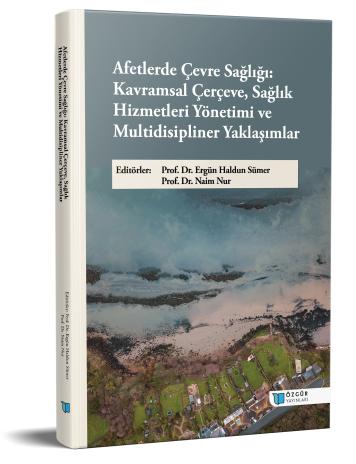
Infection Risks and Microbiological Approaches in Disasters
Chapter from the book:
Sümer,
E.
H.
&
Nur,
N.
(eds.)
2026.
Environmental Health in Disasters: A Conceptual Framework, Health Services Management, and Multidisciplinary Approaches.
Synopsis
Disasters are not only events causing physical destruction but also major public health threats that create favorable conditions for the emergence and spread of infectious diseases. Damage to infrastructure, collapse of sanitation systems, population displacement, overcrowded living conditions, weakened immunity, and environmental changes substantially increase post-disaster infection risks. This chapter systematically addresses the major determinants of infection in disaster settings, transmission pathways, disaster-specific infection profiles, and microbiological approaches. Water- and food-borne infections, respiratory tract infections, vector-borne diseases, wound and soft tissue infections, and contact-transmitted infections constitute the primary health challenges following disasters. In addition, microbiological diagnostic processes, field laboratory practices, rapid diagnostic tests, molecular techniques, culture and antimicrobial susceptibility testing, and environmental sampling approaches are reviewed. The role of epidemiological surveillance in early warning and outbreak control, together with the contribution of digital monitoring systems, is emphasized. Furthermore, infection prevention strategies—including water safety, sanitation, vaccination campaigns, vector control, isolation measures, and antimicrobial stewardship—are discussed as critical components of disaster response. Integrating microbiology with disaster medicine is considered essential for strengthening preparedness, reducing outbreak risks, and protecting public health in disaster settings.
How to cite this book
License

This work is licensed under a Creative Commons Attribution-NonCommercial 4.0 International License.
Published
DOI
Categories
Copyright (c) 2026 Ergün Haldun Sümer- Naim Nur; Serkan Çelikgün- İmran Şahin Düz- Sanem Nemmezi Karaca- Naim Nur- Nagehan Ekici Koşaroğlu- Nurcan Bağlam- İrem Akova- Şahin Yıldırım- İbrahim Furkan Sarkım- Zeynep Sümer- Yaşam Deniz- Nuriye Dinç- Yeltekin Demirel- Emre Sarı- Elif Alıcı Bıyık- Veysel Kenan Çelik- Yusuf Kenan Tekin- İlhan Korkmaz- Gülaçan Tekin- Ergün Sümer- Gülay Yıldırım- Sema Merve Sümer- Ferdağ Yıldırım