
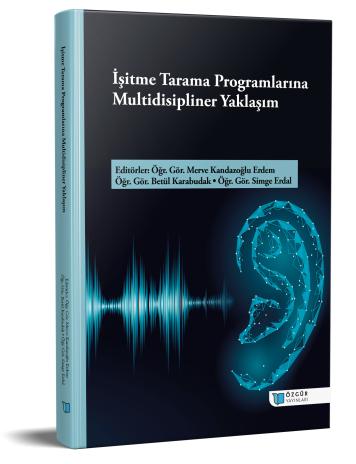
Next-Generation Biomedical Device Technologies for Hearing Screening
Chapter from the book:
Kandazoğlu Erdem,
M.
&
Erdal,
S.
&
Karabudak,
B.
(eds.)
2025.
Multidisciplinary Approach to Hearing Screening Programs.
Synopsis
Hearing screening and diagnostic systems, once based on biomedical device technologies constrained by analog limitations, low processing power, and strong dependence on clinical environments, have undergone a profound transformation driven by advances in sensor technologies, embedded system design, high-resolution digital signal processing platforms, and artificial intelligence-based analytical methods. Next-generation otoacoustic emission devices, auditory brainstem response measurement systems, and wideband acoustic immittance analyzers have become faster, more accurate, and more portable through the integration of micro-electro-mechanical system (MEMS) microphones, multifunctional probe architectures, low-noise pre-amplifier circuits, and adaptive digital filtering techniques. With the adoption of remote audiology applications, cloud-based data management infrastructures, and Internet-of-Things-enabled connectivity architectures, hearing screening practices are no longer constrained by physical location, evolving instead into continuously monitorable, data-driven, and remotely controllable structures. Artificial intelligence-enhanced Pass/Refer decision models and signal-to-noise ratio estimation algorithms are standardizing measurement and interpretation processes, while frequency-modulated transmission systems and Roger-based auditory support technologies significantly improve the effectiveness of post-screening rehabilitation. This integrated approach transforms hearing healthcare from a purely measurement-oriented practice into an intelligent, connected, and sustainable auditory health ecosystem.
How to cite this book
License

This work is licensed under a Creative Commons Attribution-NonCommercial 4.0 International License.
Published
DOI
Categories
Copyright (c) 2025 Merve Kandazoğlu Erdem- Simge Erdal- Betül Karabudak; Tuğba Ural- Merve Kandazoğlu Erdem- Simge Erdal- Esra Kuru- Betül Karabudak- Esra Sarlık- Büşra Nehir Şahin