
The Effect of Attitudes Toward Artificial Intelligence on Digital Entrepreneurship
Chapter from the book:
İnce,
M.
&
Gürsoy,
İ.
(eds.)
2025.
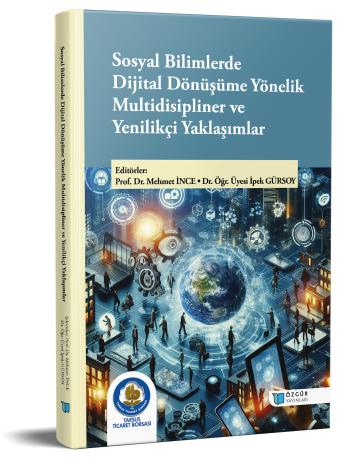
Multidisciplinary and Innovative Approaches to Digital Transformation in Social Sciences.
Synopsis
This study quantitatively examines the effect of individuals’ general attitudes toward artificial intelligence on their digital entrepreneurship intentions and behaviors. Today, artificial intelligence technologies are driving transformation across nearly all domains, from business processes to education and healthcare services. Digital entrepreneurship has emerged as a new form of entrepreneurship that leverages the opportunities offered by these technologies. Digital entrepreneurship refers to the process of creating, developing, and managing new business opportunities through the use of digital tools such as the internet, mobile technologies, and artificial intelligence. With the increasing importance of technology-oriented business models, digital entrepreneurship has become a fundamental component of the contemporary economy. The growing diffusion of artificial intelligence technologies is significantly transforming the entrepreneurial ecosystem. While the integration of artificial intelligence into business processes creates new opportunities, it also introduces various challenges. In this context, the impact of young adults’ attitudes toward artificial intelligence on their digital entrepreneurship behaviors has become an important area of research.
In this study, the relationship between general attitudes toward artificial intelligence and digital entrepreneurship is investigated. The sample consists of young adult undergraduate students. A total of 124 valid questionnaires were obtained from young adult students reached through convenience sampling. The construct validity and reliability of the attitudes toward artificial intelligence scale and the digital entrepreneurship scale were tested using exploratory factor analysis. Following correlation and multicollinearity analyses, structural equation modeling path analysis was applied to test the theoretical model and hypotheses. The analysis results indicate that the theoretical model demonstrates a good fit with the data. The findings reveal that individuals’ general attitudes toward artificial intelligence have a positive and significant effect on digital entrepreneurship (β = 0.78; p = .002). In particular, the belief that artificial intelligence can outperform humans (artificial intelligence superiority) is found to be significantly associated with digital entrepreneurship tendencies. These findings suggest that digital entrepreneurship intention is shaped not only by perceptions of the usefulness and ease of use of technology, but also by individuals’ beliefs in the transformative power of technology. The results further suggest that increasing educational content emphasizing the potential of artificial intelligence in entrepreneurship education programs may support digital entrepreneurship tendencies. In addition, it is emphasized that longitudinal studies conducted with larger and more diverse samples could provide deeper insights into the causal nature of this relationship.
How to cite this book
License

This work is licensed under a Creative Commons Attribution-NonCommercial 4.0 International License.
Published
DOI
Categories
Copyright (c) 2025 Mehmet İnce- İpek Gürsoy; Ali Şükrü Çetinkaya- Zehra Alakoç Burma- Sibel Çevik- M. Sami Süygün- Pelin Albayrak Fakıoğlu- Senay Oğuztimur- Sinan Çavuşoğlu- Kazım Dağ- Sezen Bozyiğit- Gökçer Aydın- Şükran Dertli- Recep Bozkurt- Eyyüp Akyüz- Özlem İlhan- İlknur Hatice Geçim- Zafer Yıldırım- Turgay Yıldırım- Bensu Narin- Ata Kahveci