
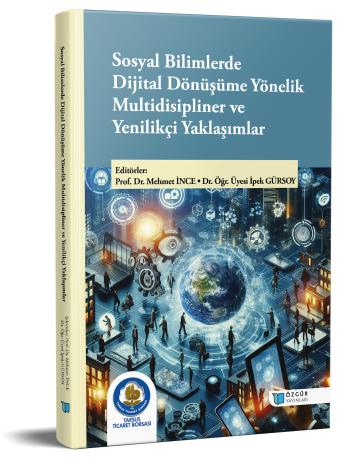
An Evaluation of the Relationship Between Anti-Aging and Transhumanism
Chapter from the book:
İnce,
M.
&
Gürsoy,
İ.
(eds.)
2025.
Multidisciplinary and Innovative Approaches to Digital Transformation in Social Sciences.
Synopsis
This study examines contemporary modes of intervention into the human body, the aging process, and the phenomenon of mortality within the conceptual frameworks of anti-aging and transhumanism. Anti-aging practices encompass medical, technological, and cosmetic interventions developed with the aim of delaying aging, preserving bodily functions, improving aesthetic appearance, and extending human lifespan. These practices include nutritional regulation, hormone and vitamin supplementation, exercise programs, aesthetic surgical interventions, stem cell therapies, and genetic modification initiatives. The anti-aging paradigm conceptualizes aging not as a natural biological process but rather as a defect to be prevented or postponed; in this respect, it transforms the human body into a project that requires continuous repair, correction, and redesign.
Transhumanism, by contrast, is a system of thought and a cultural movement that seeks not merely to slow aging but to transcend the biological, cognitive, and emotional limitations of the human condition. Developments in fields such as artificial intelligence, genetic engineering, nanotechnology, neuroscience, and cybernetics serve the transhumanist ideal of liberating humans from the constraints of nature and even transforming them into a post-human mode of existence. Within this framework, transhumanism positions the human being as an entity that reconfigures its own biological structure through engineering principles, reconceptualizing the body not as an extension of nature but as a system open to technological intervention.
The study argues that although anti-aging and transhumanism operate at different levels, they share a common objective. Both view the human body as a domain that can be enhanced, transformed, and perfected; with the advancement of modern science, the body is increasingly detached from natural limits and converted into a technical object of production. When evaluated through Foucault’s concept of biopolitics, this transformation reveals that modes of power aimed at disciplining, regulating, and governing the body continue in digitized forms.
The study also discusses the ethical, religious, and sociological implications of anti-aging and transhumanism. Conceptualizing aging as a “defect” or “disease” reshapes both individual body perception and consciousness of death. Technological interventions that push the boundaries of human nature generate new philosophical and theological debates concerning the value of life, the natural order, moral responsibility, and divine will. Ultimately, anti-aging and transhumanism are evaluated not merely as forms of resistance to biological aging, but as efforts to reproduce the modern human desire for immortality within scientific, cultural, and ideological frameworks.
How to cite this book
License

This work is licensed under a Creative Commons Attribution-NonCommercial 4.0 International License.
Published
DOI
Categories
Copyright (c) 2025 Mehmet İnce- İpek Gürsoy; Ali Şükrü Çetinkaya- Zehra Alakoç Burma- Sibel Çevik- M. Sami Süygün- Pelin Albayrak Fakıoğlu- Senay Oğuztimur- Sinan Çavuşoğlu- Kazım Dağ- Sezen Bozyiğit- Gökçer Aydın- Şükran Dertli- Recep Bozkurt- Eyyüp Akyüz- Özlem İlhan- İlknur Hatice Geçim- Zafer Yıldırım- Turgay Yıldırım- Bensu Narin- Ata Kahveci