
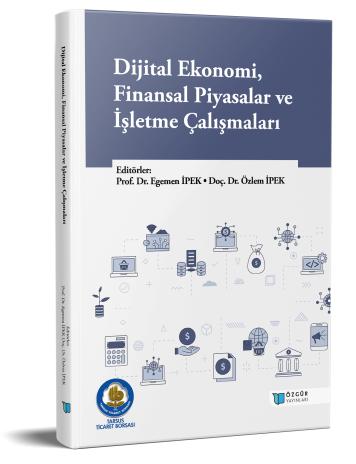
The Effects of Digitalized Accounting on Accounting Professionals: The Case of Mersin Province
Chapter from the book:
İpek,
E.
&
İpek,
Ö.
(eds.)
2025.
Digital Economy, Financial Markets, and Business Studies.
Synopsis
Digitalization is advancing rapidly, and adaptation to technology and innovation is causing changes across all areas of life. With the emergence of digital information, the cost of accessing knowledge and the time-consuming efforts previously required have been significantly reduced. Through internet usage, digital information has become globally influential and has emerged as a key concept for the private sector, the public sector, and all types of organizations. The source of information that brings distant places closer is digital knowledge. It is a well-established fact that societies and businesses that fail to adapt to digitalization experience difficulties in taking forward-looking steps.
As in many parts of the world, digitalization has also gained importance in the field of accounting in Türkiye. In particular, as technological advancements continue, ease of access to information has become increasingly embedded in the accounting profession. Digital accounting is a system that replaces paper-based accounting processes by enabling the storage, processing, and transmission of financial data in electronic environments. The ability to rapidly access and utilize traditional accounting information through digital platforms has provided significant advantages.
Today, while accounting professionals gain certain benefits from digital transformation in the execution of their profession, they also face several challenges. In this context, the aim of this study is to examine the effects of digitalized accounting on accounting professionals, including Certified Public Accountants, Sworn-in Certified Public Accountants, and accounting interns who are in the process of entering the profession. The sample of the study consists of 10 accounting professionals operating in the Tarsus district of Mersin Province in 2025.
The study employs a qualitative research design, using in-depth structured interviews conducted through the snowball sampling technique. The findings indicate that participants have adapted to and support the developments and changes expected to occur in the accounting profession as a result of digitalization. The results further suggest that digital transformation will change the role of accounting professionals, enabling them to perform tasks that require not only technical knowledge but also advanced expertise, thereby reshaping their job descriptions.
In addition, it is found that accounting professionals most frequently encounter challenges related to system integration, infrastructure deficiencies, and taxpayers’ difficulties in using digital documents. On the other hand, digitalization provides notable advantages such as time and cost savings, immediate detection of errors, increased transparency in auditing processes, and the prevention of informal economic activities.
How to cite this book
License

This work is licensed under a Creative Commons Attribution-NonCommercial 4.0 International License.
Published
DOI
Categories
Copyright (c) 2025 Egemen İpek- Özlem İpek; Gökhan Berk Özbek- Ahmet Koluman- Fatih Kaplan- Yıldız Hoşgör- Nilüfer Yücedağ Erdinç- Emrah Eray Akça- Ayşegül Han- Turgay Yıldırım- Zafer Yıldırım- Saffet Akdağ- Ayşe Akboz Caner - Ayşe Ergin Ünal- Sinan Çavuşoğlu- Özlem Doğan- Mehmet Ali Ekinci- Sevil Özen- Kemal Eyüboğlu- Senem Gazi- Ulaş Buz- Mehtap Delioğlu- Burcu Karaca- Ali Çımat- Sinem Eyüboğlu- Nurten Çakar- Ömer Arı- Erkan Uzun