
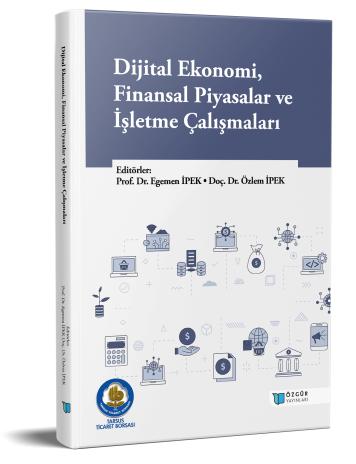
The Relationship Between Digitalization and the Shadow Economy: Empirical Evidence from Euro Area Countries
Chapter from the book:
İpek,
E.
&
İpek,
Ö.
(eds.)
2025.
Digital Economy, Financial Markets, and Business Studies.
Synopsis
Economic activities operating outside the scope of official national income accounts render the processes of policy formulation and implementation more complex for countries striving for economic development or growth. On the one hand, shadow economic activities lead to fiscal deterioration through their negative effects on tax revenues and public debt; on the other hand, they may generate adverse outcomes for the financial sector by contributing to high inflation and interest rates, as well as downgrades in a country’s credit rating. For these reasons, preventing or minimizing the shadow economy has become one of the priority objectives of governments, given its country-specific and multifaceted negative consequences. To this end, contemporary policy frameworks and strategies increasingly place digitalization at their core.
Digitalization enables more effective control and monitoring mechanisms in public finance, while simultaneously creating new business models that may pose challenges for taxation and, in some cases, contribute to the expansion of the shadow economy. Building on this problematique, this study empirically investigates the effects of digitalization on the shadow economy for Euro Area countries over the period 2006–2020. Digitalization is proxied by the share of individuals using the internet in the total population, while data on the size of the shadow economy—derived from estimations based on a dynamic general equilibrium framework—are expressed as a percentage of official gross domestic product.
To enhance the explanatory power of the model and the robustness of the findings, three control variables are incorporated into the econometric specification: research and development (R&D) expenditures, the unemployment rate, and the inflation rate. In this context, panel data for 20 Euro Area countries are analyzed using the Poisson Pseudo-Maximum Likelihood (PPML) estimation method. The empirical results indicate a negative relationship between digitalization and the shadow economy. In other words, increases in the level of digitalization are associated with reductions in shadow economic activities. This finding suggests that digitalization plays an effective role in combating informality in Euro Area countries, particularly by making tax evasion more difficult.
Furthermore, the results reveal that increases in unemployment and inflation rates tend to encourage shadow economic activities, whereas R&D expenditures exert a negative effect on the size of the shadow economy. Considering that R&D activities are often conducted in close integration with the components of digitalization, advancements in digitalization-oriented R&D efforts may further contribute to the prevention of informal economic activities. Overall, the findings underscore the importance for Euro Area countries of effectively utilizing the full range of opportunities offered by the digital age in order to minimize the size of the shadow economy.
How to cite this book
License

This work is licensed under a Creative Commons Attribution-NonCommercial 4.0 International License.
Published
DOI
Categories
Copyright (c) 2025 Egemen İpek- Özlem İpek; Gökhan Berk Özbek- Ahmet Koluman- Fatih Kaplan- Yıldız Hoşgör- Nilüfer Yücedağ Erdinç- Emrah Eray Akça- Ayşegül Han- Turgay Yıldırım- Zafer Yıldırım- Saffet Akdağ- Ayşe Akboz Caner - Ayşe Ergin Ünal- Sinan Çavuşoğlu- Özlem Doğan- Mehmet Ali Ekinci- Sevil Özen- Kemal Eyüboğlu- Senem Gazi- Ulaş Buz- Mehtap Delioğlu- Burcu Karaca- Ali Çımat- Sinem Eyüboğlu- Nurten Çakar- Ömer Arı- Erkan Uzun