
Digitalization and Income Inequality in Türkiye: A Johansen Cointegration Analysis from a Dual Labor Market Perspective
Chapter from the book:
İpek,
E.
&
İpek,
Ö.
(eds.)
2025.
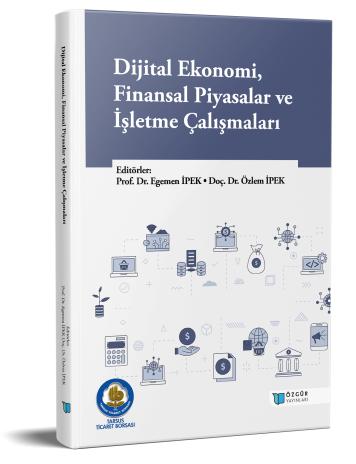
Digital Economy, Financial Markets, and Business Studies.
Synopsis
Income distribution equity is one of the most critical indicators in countries’ economic and social development processes. With the acceleration of digital transformation, its effects on income inequality have become a subject of intense debate among both academic circles and policymakers. Polarization in the labor market driven by digitalization deepens income inequality, as highly skilled labor benefits from higher earnings while low-skilled labor is increasingly pushed into insecure and low-wage jobs. This dynamic renders the distinction between “good jobs” and “bad jobs,” as proposed by dual labor market theory, particularly visible in the context of Türkiye.
This study examines the long-run effects of digitalization on income inequality in Türkiye over the period 2003–2022 using Johansen cointegration analysis. Research and development (R&D) expenditures and information and communication technology (ICT) services exports are employed as indicators of digitalization, while the Gini index is used as the dependent variable representing income inequality. The empirical results indicate that a 1% increase in ICT services exports increases income inequality by approximately 2.79%, whereas a 1% increase in R&D expenditures reduces income inequality by about 10.08%. The error correction coefficient (–0.60) suggests that the model adjusts rapidly to long-run equilibrium, with deviations converging back to a stable path in less than one period.
Overall, the findings reveal that digital transformation tends to exert an inequality-increasing effect in the short run; however, in the long run, income disparities can be mitigated through policies that strengthen R&D investment and human capital.
How to cite this book
License

This work is licensed under a Creative Commons Attribution-NonCommercial 4.0 International License.
Published
DOI
Categories
Copyright (c) 2025 Egemen İpek- Özlem İpek; Gökhan Berk Özbek- Ahmet Koluman- Fatih Kaplan- Yıldız Hoşgör- Nilüfer Yücedağ Erdinç- Emrah Eray Akça- Ayşegül Han- Turgay Yıldırım- Zafer Yıldırım- Saffet Akdağ- Ayşe Akboz Caner - Ayşe Ergin Ünal- Sinan Çavuşoğlu- Özlem Doğan- Mehmet Ali Ekinci- Sevil Özen- Kemal Eyüboğlu- Senem Gazi- Ulaş Buz- Mehtap Delioğlu- Burcu Karaca- Ali Çımat- Sinem Eyüboğlu- Nurten Çakar- Ömer Arı- Erkan Uzun