
The Relationship Between Economic Growth, Foreign Direct Investment, and Democracy in Türkiye: An ARDL Approach (1994–2024)
Chapter from the book:
İpek,
E.
&
İpek,
Ö.
(eds.)
2025.
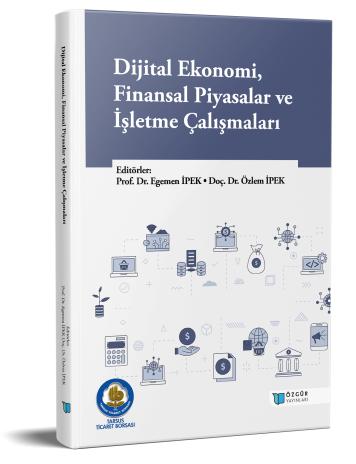
Digital Economy, Financial Markets, and Business Studies.
Synopsis
This study empirically examines the relationship between economic growth and foreign direct investment (FDI), the level of democracy, energy consumption, and trade openness in the Turkish economy over the period 1994–2024. The primary aim of the study is to identify the short- and long-run interactions among these variables in order to better understand Türkiye’s sustainable growth dynamics. To test for the existence of a cointegration relationship among the variables, the ARDL bounds testing approach is employed. The ARDL framework allows for the joint evaluation of both short- and long-run dynamics.
The empirical findings indicate the presence of a long-run cointegration relationship among economic growth, foreign direct investment, democracy level, energy consumption, and trade openness. This result suggests that the variables move together in the long run and exert balancing effects on one another. According to the estimation results, the effect of foreign direct investment on economic growth is found to be negative and statistically significant, contrary to conventional expectations. This outcome may be associated with the nature of foreign capital inflows into Türkiye, which have largely taken the form of privatizations, financial acquisitions, or short-term profit-oriented investments. Moreover, the concentration of investments in service sectors or low value-added activities rather than productive sectors, profit repatriation, and institutional infrastructure deficiencies may be considered among the main reasons underlying this negative effect.
In contrast, improvements in the level of democracy, increases in energy consumption, and greater trade openness are found to have positive effects on economic growth. Democratization is believed to enhance investor confidence and stimulate economic activity through channels such as the rule of law, transparency, accountability, and improvements in the investment climate. Furthermore, the strengthening of democratic institutions reduces political uncertainty and enables more stable long-term investment decisions, thereby supporting the sustainability of economic growth. Energy consumption emerges as one of the key determinants of growth due to its strong linkage with industrialization, expansion of production capacity, and technological progress.
Overall, the findings underscore the critical importance of policy designs aimed at strengthening democratic institutions, improving energy efficiency, and directing foreign direct investment toward productive and innovative sectors in line with Türkiye’s sustainable growth objectives. Additionally, increasing the share of high-technology products in exports and implementing trade policies within a competitiveness-oriented framework are deemed essential for sustaining long-term economic growth performance.
How to cite this book
License

This work is licensed under a Creative Commons Attribution-NonCommercial 4.0 International License.
Published
DOI
Categories
Copyright (c) 2025 Egemen İpek- Özlem İpek; Gökhan Berk Özbek- Ahmet Koluman- Fatih Kaplan- Yıldız Hoşgör- Nilüfer Yücedağ Erdinç- Emrah Eray Akça- Ayşegül Han- Turgay Yıldırım- Zafer Yıldırım- Saffet Akdağ- Ayşe Akboz Caner - Ayşe Ergin Ünal- Sinan Çavuşoğlu- Özlem Doğan- Mehmet Ali Ekinci- Sevil Özen- Kemal Eyüboğlu- Senem Gazi- Ulaş Buz- Mehtap Delioğlu- Burcu Karaca- Ali Çımat- Sinem Eyüboğlu- Nurten Çakar- Ömer Arı- Erkan Uzun